As a professional custom web development company, we have taken the initiative to explain why customized websites have become so popular among businesses recently.
Here, we discuss the benefits of custom web development and the myths surrounding it.
This quick guide will help entrepreneurs, non-technical readers, startups, and business leaders to understand this topic more clearly.
Why Businesses Prefer Custom Web Development?
Businesses choose customization, as it offers more control, performance, and flexibility than off-the-shelf platforms can offer. There are 4 major reasons to understand this change:
- Scalability: Unlike templates, custom solutions grow with the business. It offers scalability that helps businesses to add new features, handle higher traffic, and expand into new markets without performance bottlenecks.
- API integrations: Many businesses rely on third-party tools, like CRMs, ERPs, payment gateways, marketing platforms, and analytics systems. By choosing customization, you make seamless API integration easy and efficient.
- Ecommerce Growth: Ecommerce businesses are growing massively in 2025; every business wants to give a unique and advanced experience. Customization offers flexibility to fulfill the customer’s expectations.
- Competitive Differentiation: With increasing digital competition, standing out with a unique brand voice is the best business strategy. Businesses choose customization for unique designs, features, and user experiences that reflect their brand identity.
What People Think “Custom Web Development” Means
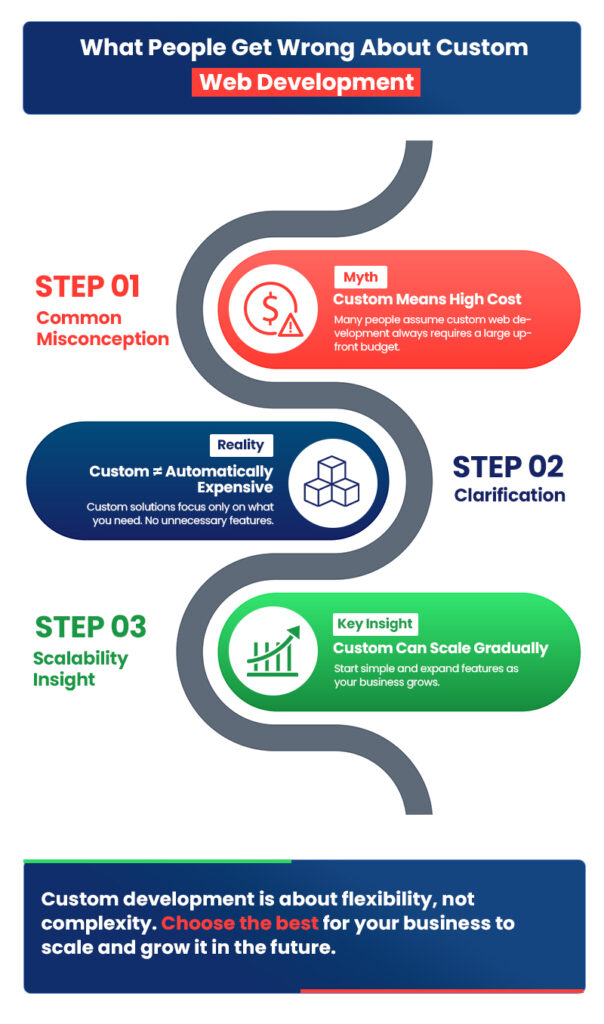
There are various misconceptions about custom web development. Myths like “it’s expensive,” “it’s only for big companies,” or “a template is a better option” are making many businesses suffer.
It’s understandable that custom web development can have a high up-front cost, but it’s less expensive than template solutions in the long run. Choosing a template option or an off-the-shelf solution for your business just to save plugin fees, forced upgrades, and performance limitations can cause big worries in the future.
Another myth is that web customization is only for large companies and enterprises. However, many startups and small businesses can take advantage of it to its fullest potential by building only the features they actually need. This cuts down the cost of carrying unnecessary features in template websites.
A basic belief that templates can perform better is no different than a myth. They can fulfill basic needs but have their own limitations. Business leaders know that when a business grows, its online presence also needs to increase. It needs improved performance, advanced integrations, strong security, and customization, and it provides exactly that. Custom solutions are more scalable, and they have the capability to grow with the business.
What Custom Web Development Actually Means
Custom web development means building a website or a web application around your product, services, or business specifically.
So, instead of forcing your business to perform on a one-size-fits-all solution, you hire a professional custom web development company to build tailored designs and develop required features for your website or web application.
Custom web development takes into consideration your requirements, such as workflows, goals, and target customers. It builds a functionality that supports specific business operations, improves efficiency, and delivers a better user experience.
One of the top benefits of customization is the ability to create advanced integrations, custom dashboards, complex user roles, and specialized automation, which is only possible on a custom development platform, not on templates. It allows full flexibility to add or modify features without technical restrictions.
Best of all, customization lets clients own their online presence completely. Let it be code, structure, or data; there are no specific platforms’ rules, pricing, or updates. This ownership gives you long-term control, better security, and freedom to scale as your business grows.
Template vs. Custom: When Each One Makes Sense
This quick table will help you understand when you should choose each for your business. Templates help you get online quickly, while custom development helps you grow, scale, and differentiate.
| Aspects | Template Website | Custom Website |
|---|---|---|
| Best for | Simple websites, blogs, and landing pages. | Web apps, dashboards, portals, workflows. |
| Setup time | Very fast. | Longer but planned. |
| Initial cost | Lower. | Longer but planned. |
| Flexibility | Limited to theme & plugins. | Fully flexible. |
| Scalability | Limited. | Built to scale. |
| Integrations | Basic or plugin-based. | Advanced API integrations. |
| Ownership | Platform-dependent. | Full ownership. |
| Long-term value | Short to mid-term. | Long-term investment. |
Common Problems Templates Cannot Solve
To put it simply, templates are built for average use cases, while customized solutions grow with the business and fulfill the real-time needs. Here are the top problems that businesses usually face after choosing one-size-fits-all templates to save time and money.
- Templates struggle when a website needs step-by-step processes like approvals, role-based access, or custom user journeys.
- Templates rely heavily on plugins. When businesses need deep integration with CRMs, ERPs, payment systems, or third-party APIs, plugins sometimes conflict, break down, or slow down the website.
- Most templates load extra code, features, and scripts users don’t even need. This makes websites slower, especially under high traffic.
- Templates share common structures, which makes them easier targets for attacks. As traffic grows, they also struggle to scale.
- Changing layouts, logic, or functionality beyond basic settings can be difficult or impossible.
Real-World Examples of Custom Web Applications
We have used top real-world examples to make the custom web application development easily understandable. Without customized solutions, these amazing products wouldn’t exist today.
- Uber: A perfect example of a fully custom web and mobile application. It handles real-time location tracking, dynamic pricing, secure payments, and notifications.
- Airbnb: It chose custom development years ago to manage property listings, availability calendars, user profiles, messaging, reviews, payments, and search filters, all of this efficiently.
- Amazon: A highly customized e-commerce platform with personalized recommendations, inventory management, order tracking, seller dashboards, and AI-driven search.
- Netflix: It includes user profiles, recommendation engines, content delivery optimization, and subscription management, all possible through a customized solution.
The Hidden Costs of Cheap Template Websites
No doubt that at first glance, affordable template websites look like a time-saving, smart, and budget-friendly option. It has a low upfront cost and promises a fast launch. However, behind the curtains, these websites come with hidden drawbacks in the long run that can cause businesses a nightmare. At the same time, it will affect the website’s performance, security, and scalability.
Code Bloat
Template websites rely on multiple third-party plugins to add basic functionality such as forms, SEO tools, page builders, sliders, and security. Every plugin comes with extra code, increased load time, and a risk of conflicts during updates. Plugin overloads can make the website harder to maintain.
Security
It is no secret that hackers favor template websites. Templates and plugins are common targets for hackers because thousands of websites use the same codebase. If one plugin has a vulnerability, every site using it becomes exposed. Cheap templates damage search engine trust and SEO rankings because they are poorly maintained and have delayed updates, which can lead to data breaches, malware injections, and downtime.
SEO
Typically, most website templates do not have the correct semantic structure and HTML markup, which makes the website’s content hardly understandable for search engines. It is clear that cheap template websites are not suitable for long-term SEO growth and cannot rank for competitive keywords.
The main point is that templates cannot be customized the way your business demands. They are designed for everyone, not for a specific target audience in mind. The crowd of bloated code, unused features, and heavy scripts that are not even needed for your audience makes the website slow. Slow websites mean increased bounce rates, broken user experience, and negative impact on search engine rankings.
Template websites are fine if you have basic business offerings. However, if you wish for differentiation, branding, and long-term benefits, custom development is always a sustainable choice.
What People Get Wrong About Custom Web Development
When Custom Development Supports Business Growth
Custom web development is an essential option for every business that wants to go beyond basic online presence with a strong focus on scalability, efficiency, and competitive advantage. Customized solutions are built according to real business workflows and future growth in mind.
Ecommerce Brands
The benefits custom web development offers for e-commerce businesses:
- Customized checkout flows that reduce cart abandonment.
- Custom product filtering, pricing rules, and inventory logic.
- Integration with ERPs, CRMs, payment gateways, and shipping systems.
- Faster performance during high traffic and sales campaigns.
SaaS Startups
SaaS products demand unique functionality at a high level. Custom development supports:
- Secure user authentication and role-based access.
- Subscription management and billing logic.
- Scalable dashboards and data visualization.
- API-first architecture for integrations and future expansion.
Service-Based Businesses
For agencies, consultants, healthcare providers, or logistics companies, custom solutions help by:
- Automating booking, inquiries, and client onboarding.
- Building custom portals for clients, staff, or vendors.
- Integrating CRM systems for lead and customer management.
Operational Automation
One of the biggest growth advantages of custom development is automation, including:
- Automated reporting and data syncing.
- Workflow automation between departments.
- Custom admin panels to manage operations efficiently.
Conclusion for Why Custom Web Development Became So Popular in 2025
Businesses that want to scale and grow in the future should choose custom web development, which offers long-term benefits. DynamoLogic Solutions has been in the industry for 17+ years, and we have developed hundreds of custom websites and web applications for startups, enterprises, small businesses, and business leaders. Explore more about our web development services that offer free 24/7 technical support, cost-efficiency, and an experienced team of developers and designers.
FAQs
1. Is custom web development expensive?
Custom website development is usually considered expensive because it’s fully built around your specific business needs and offers security, scalability, and improved performance.
2. Do startups need custom development?
Yes, custom web development is a sustainable choice that suits every business module, whether it be a startup or an enterprise. It’ll only offer the features, plugins, and integrations that your business actually needs, which makes the website faster and improved.
3. Can a site start with a template and later upgrade to custom?
Yes, websites can start with one-size-fits-all templates and can later upgrade to customization options with the help of a professional custom web development company.
4. How long does custom development take?
The period of custom web development varies depending on the required features, plugins, and customization level. Roughly, simple projects take a few months, while deep-customization projects can take around a year.
5. Are custom-built websites more secure?
Yes, customized websites are more secure and reliable because they don’t have common vulnerabilities of popular platforms, such as WordPress. Developers build a security system from scratch that offers better protection against hacking or malware attacks.