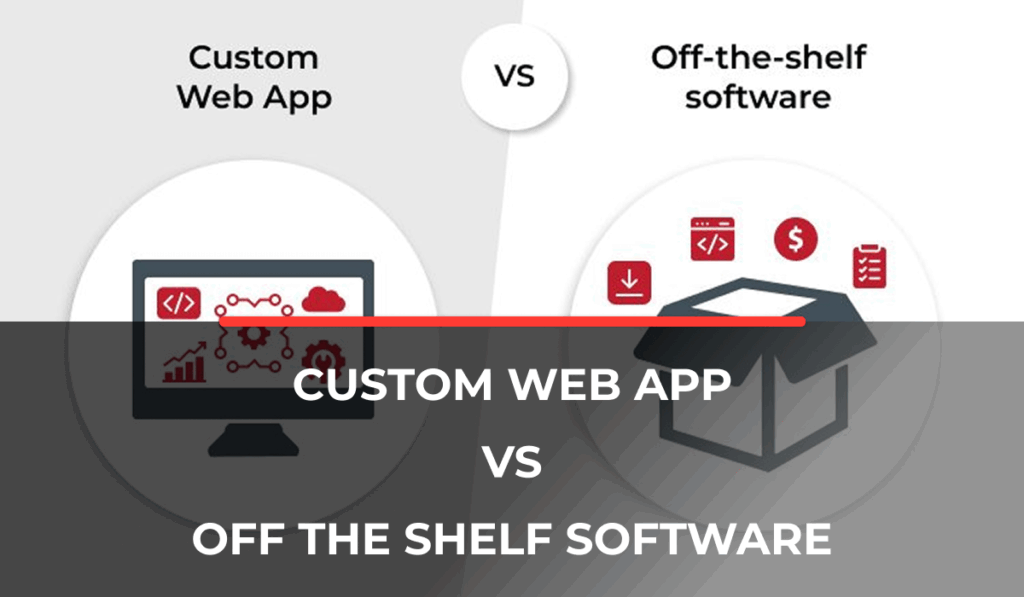
Choosing custom web apps vs. off-the-shelf software is the most common and costly decision businesses make. The right choice helps business owners, startup founders, and operations managers improve the overall operations and performance. And a wrong one can lead to wasted budgets, ruined systems, and tools that no longer fit with the business requirements.
Choosing custom web apps vs. off-the-shelf software is the most common and costly decision businesses make. The right choice helps business owners, startup founders, and operations managers improve the overall operations and performance. And a wrong one can lead to wasted budgets, ruined systems, and tools that no longer fit with the business requirements.
This guide provides a clear comparison of a custom web application and off-the-shelf software, with their advantages, limitations, costs, and real-world examples. The goal of this guide is not to promote one option over the other but to help you choose the best according to your business needs.
What is a Custom Web Application?
A custom web application is software that is built specifically to meet the unique needs of your business or organization. Unlike off-the-shelf software, it is built from scratch to match the business workflows, processes, and goals, which gives full control over features, designs, and functionality to business owners.
They usually have customized dashboards, automated processes, and specialized integrations that cannot be provided by any pre-built software. It offers unlimited customization, helping businesses improve sales, productivity, and overall performance.
Here are real-life examples of custom web applications to better understand:
- Netflix is a custom web application that manages streaming, recommendations, and content delivery.
- Airbnb is a unique platform to handle listings, bookings, and payments.
- Slack is a team collaboration platform that scaled globally.
Pros & Cons of Custom Web Applications
Listed below are the pros and cons of a custom web application:
Pros:
- It offers full flexibility and is built around your unique business needs.
- Business owners fully own the software, which provides complete control over updates, features, and integrations.
- Customized solutions can grow with your business and can adapt to increased users, data, and internal processes.
- Every feature of the custom web app is designed to match your specific operations.
Cons:
- Developing a custom solution requires more upfront cost compared to off-the-shelf software.
- Building tailored software takes time, from planning and design to development and deployment.
What is Off-the-Shelf Software?
Off-the-shelf software is pre-built software designed to serve a wide range of users and industries. This software is built with advanced features and is available for immediate use without any need for customization.
Off-the-shelf software is built for the mass market and comes with standard features, with some limitations. Businesses choose it for immediate use by signing up, configuring the basic settings, and adapting their process to fit the software. However, this software is not built for one specific business; its flexibility, scalability, and integration options can be limited when the business grows in the future.
Common real-life off-the-shelf software examples include:
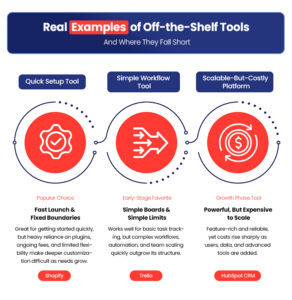
- Trello for task and project management.
- Asana for team collaboration and workflow tracking.
- HubSpot for CRM, marketing, and sales automation.
Pros & Cons of Off-the-Shelf Software
Let’s understand the pros and cons of off-the-shelf software to make an informed decision.
Pros:
- It is ready to use immediately, and teams can start working without delays.
- It offers low upfront costs, as it comes with a subscription or a one-time license.
- It is widely supported. Popular tools have large communities, regular updates, and vendor support.
Cons:
- It provides limited flexibility since the software is designed for general use.
- Adding functionality often requires multiple plugins or add-ons, which can cause plugin overload sometimes.
- As the business grows, it requires more advanced functionality and features that pre-built software cannot offer.
- It can cost less initially, but recurring fees can increase over time.
Custom Web App vs. Off-the-Shelf
This table compares the custom web app and off-the-shelf software in terms of cost, timeline, security, and maintenance.
| Factors | Custom Web Applications | Off-the-Shelf Software |
|---|---|---|
| Cost | Higher initial investment, but long-term value and no recurring license fees. | Lower upfront cost; subscription or license-based. |
| Timeline | Longer development time; planning, design, and deployment are required. | Immediate or very quick setup. |
| Scalability | Highly scalable; can grow seamlessly with your business needs. | Limited; may require workarounds or additional tools as business grows. |
| Security | Full control over security; custom measures can be implemented based on your requirements. | Vendor-managed; updates and patches handled by the provider. |
| Ownership | Full ownership; you control the software, data, and future modifications. | Software is owned by the vendor; access depends on the license. |
| Maintenance | Maintenance responsibility lies with you or your development team. | Vendor handles updates, support, and bug fixes. |
Real Examples of Off-the-Shelf Tools
When Custom Development Is the Better Choice
Custom web applications are the right choice when your business requires solutions built for complex operations, unique workflows, or long-term scalability. They are designed to grow and adapt with your organization and offer full control over functionality and user experience. Such as:
- Complex business operations: Businesses with specialized processes, such as supply chain management, custom reporting, or industry-specific workflows, benefit from software built specifically for their needs.
- Multi-role dashboards: If your system must support different user roles with customized dashboards, permissions, and reporting, then a custom solution has exactly what you need.
- Automation requirements: Companies looking to automate repetitive tasks, integrate multiple systems, or streamline workflows will find custom applications much more effective than off-the-shelf alternatives.
- Scalability needs: When your business requires quick growth, an expanding user base, or increased data demands, then custom development can make sure your software can scale efficiently without major limitations.
Choosing custom development provides long-term flexibility, full ownership, and the ability to implement features that directly support your business strategy.
Ready to Invest in Custom Solutions?
DynamoLogic Solutions’ custom web development services can help design and build software that aligns with your exact requirements.
When Off-the-Shelf Is the Best Choice
Off-the-shelf software is ideal for businesses with average needs, limited budgets, or a desire for quick setup. It works best when your workflows are common and do not require much customization. Some typical use cases include:
- Simple websites: If your business only needs a basic online presence, an off-the-shelf website builder or CMS can get you live quickly without significant development.
- Small businesses: Companies with smaller teams or limited technical resources benefit from ready-made tools that require minimal setup and maintenance.
- Standard workflows: Businesses with common processes, like basic project management, accounting, or email marketing, can also choose popular off-the-shelf solutions.
- Limited budget: Off-the-shelf software usually has lower upfront costs, which makes it accessible for organizations that cannot invest heavily in custom development.
Cost Differences: Short-Term vs. Long-Term
Understand the cost differences between custom web applications and off-the-shelf software. This table highlights short-term vs long-term costs and hidden expenses to consider.
| Factors | Custom Web Applications | Off-the-Shelf Software |
|---|---|---|
| Initial Cost | Low upfront cost. | High upfront investment. |
| Ongoing Cost | Recurring subscription or license fees. | Minimal recurring cost; mostly upfront investment. |
| Hidden Costs | Extra plugins, integrations, or scaling may increase expenses. | Mostly planned upfront; fewer surprises. |
| Long-Term Value | It may become costly over time due to subscriptions. | High long-term value; customized to business needs. |
Scalability & Flexibility: The Deciding Factor for Growing Businesses
Scalability and flexibility are important when choosing software. This table shows how custom web applications and off-the-shelf solutions differ in adapting to growth.
| Factors | Custom Web Applications | Off-the-Shelf Software |
|---|---|---|
| Scalability | Highly scalable; grows seamlessly with your business. | Limited; often tied to pricing tiers or technical constraints. |
| Flexibility | Fully flexible; workflows, dashboards, and automation built for your processes. | Restricted to existing features; may require workarounds or plugins. |
| Adaptability to Change | Software adapts to your unique workflows and changing needs. | May require adjusting business processes to fit the software. |
How to Choose the Right Option for Your Business
Choosing between a custom web application and off-the-shelf software can feel overwhelming, but focusing on a few key factors makes the decision clearer. Consider your timeline, budget, workflow complexity, integrations, and future growth to determine which solution aligns with your needs.
Quick Checklist:
- Timeline: If you need a fast solution, off-the-shelf is quicker; custom takes longer.
- Budget: Off-the-shelf has lower upfront costs; custom requires a higher initial investment but offers long-term value.
- Workflow Complexity: Standard workflows suit off-the-shelf; unique processes need custom solutions.
- Integrations: Custom apps can connect seamlessly; off-the-shelf apps may require plugins.
- Future Growth: Custom scales with your business; off-the-shelf may have limits or require upgrades.
By reviewing these factors, you can make an informed decision that balances cost, functionality, and long-term business goals.
When You Need a Development Team (And When You Don’t)
Not every software project requires a full development team, but some situations make professional technical support important to have. You will require a development team when your project involves custom workflows, secure data management, or deep integrations with multiple systems. These situations require careful planning, coding expertise, and ongoing maintenance to make sure your software functions reliably and securely.
On the other hand, if your business needs are straightforward, like a simple website, standard project management, or basic marketing tools, an off-the-shelf solution may be sufficient, and you might not need a dedicated team.
For businesses looking to build customized solutions with complex requirements, DynamoLogic Solutions’ custom web application development services can provide end-to-end support, from planning and development to deployment and maintenance. Partnering with an experienced team makes sure your custom web application meets your business goals efficiently and securely.
Ready to Invest in Custom Web Apps?
Partner with DynamoLogic Solutions for tailored web app development that perfectly matches your business needs.
FAQs
1. Is custom software better than off-the-shelf?
It depends on your business needs. Custom software offers full flexibility, scalability, and ownership. Off-the-shelf software is better for standard processes, quick deployment, and lower upfront costs.
2. When should I choose a custom web app?
Choose a custom web application if your business requires unique workflows, automation, multi-role dashboards, or seamless integrations with other systems. Custom solutions are also best when long-term scalability and full control are priorities.
3. Is off-the-shelf software cheaper?
Yes, off-the-shelf software generally has a lower upfront cost since it’s pre-built. However, recurring subscription fees, plugin costs, and limitations in scalability can make it more expensive.
4. Can a business start with off-the-shelf and later go custom?
Yes. Many businesses start with off-the-shelf solutions to get started quickly and validate processes, then migrate to custom software once their needs grow.
5. How long do custom web applications take to build?
The timeline varies based on complexity, features, and integrations. Simple custom applications can take a few weeks, while more complex systems with multiple workflows and automation can take several months.