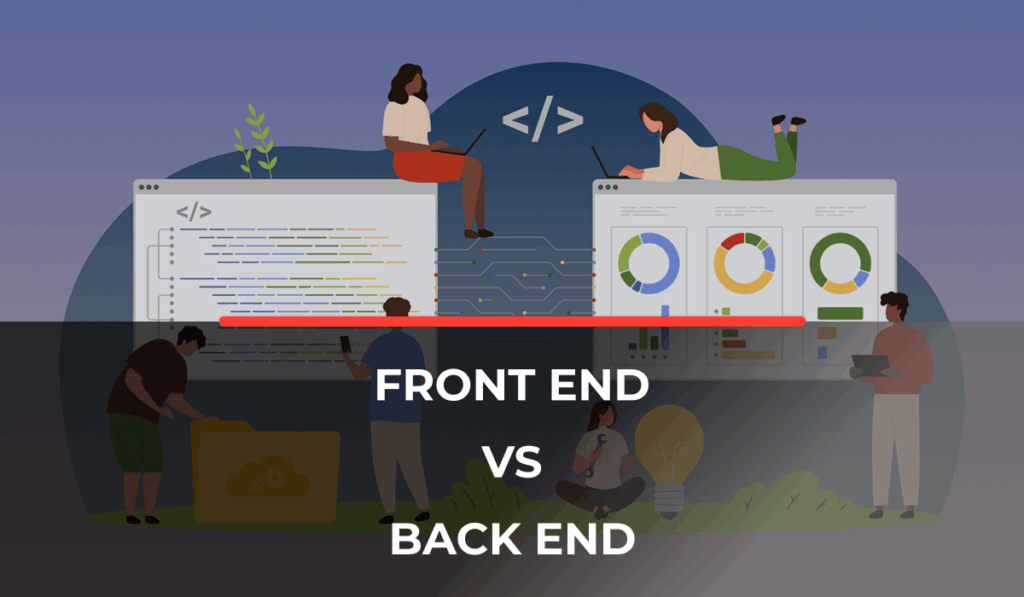
Today, we explain everything you need to know about frontend development and backend development in 2026. This guide helps students, beginners, and business professionals understand programming paths and developer roles clearly.
This detailed guide will explain what a web developer is, what a frontend and backend web developer does, their responsibilities, who is better, and how to become one, and it will provide a detailed comparison for better understanding.
What is Frontend Development?
“Frontend” refers to everything you see visually or interact with on a website or application.
Frontend includes all the elements that users experience directly, such as pages, buttons, menus, images, forms, and animations. When someone visits a website, the frontend loads in their browser and allows them to navigate, read content, and complete actions such as filling out a form or making a purchase.
Frontend development is the process by which frontend developers build the user interface (UI) and user experience (UX) of a website or web application using web technologies such as HTML, CSS, and JavaScript.
These technologies make the website functional, interactive, and visually engaging. It includes everything the user sees or clicks, such as layout & structure, design & visuals, user interactions, responsiveness across devices, and browser performance.
When a user visits the site, the frontend code instructs web browsers, such as Chrome, Safari, or Edge, on how to display the website or web application. Browsers read the frontend files and render the page’s structure, styling, layout, and interactive behavior.
Frontend developers make it all possible without any technical issues. A frontend web developer builds and maintains the visual and interactive parts of a website or web application. Their responsibility is to ensure users can easily view, navigate, and interact with the site while having a smooth experience.
What is Backend Development?
It handles request processing and data management to ensure everything runs efficiently and securely. Backend code manages everything that happens after a user clicks a button, submits a form, logs in, or requests data. When the backend receives an action, it processes it and sends back the correct response to the frontend (what the user sees or clicks).
To build backend code, developers typically use technologies and frameworks such as PHP, Laravel, Node.js, Python, and Java.
Backend development is built around three core components: servers, APIs, and databases. All 3 components ensure that the website and web apps store data, retrieve it when needed, and update it in real time.
| Servers | These systems receive requests from users’ browsers, process them, and return the correct response. |
| APIs | APIs act as messengers, enabling the frontend to communicate with the backend by sending requests and receiving data securely. |
| Databases | Databases store all important information such as user accounts, content, orders, and transaction records. |
The backend contains the business logic of a website or application. It determines what happens when a user submits a form, how data is validated and processed, which information a user can access, and how workflows and automated processes run. This logic ensures the application behaves correctly in accordance with business rules and user actions.
In short, a backend developer makes sure the website and web application are secure, reliable, and functional. It includes developing APIs and server logic, managing databases and data flow, implementing authentication and security measures, and optimizing performance and scalability.
Key Differences Between Frontend & Backend Development
The table below provides a quick comparison of frontend and backend development, including purpose, roles, skills, tools, and difficulty levels. Frontend developers handle user-facing experience, while backend developers handle logic, data, and security. Both are essential and have to work together for a better experience.
| Aspects | Frontend Development | Backend Development |
|---|---|---|
| Purpose | Focuses on what users see and interact with on a website or web application. | Focuses on how the website or application works behind the scenes. |
| Core Role | Builds the user interface and user experience. | Builds the logic, data handling, and system functionality. |
| Skills Required | UI/UX understanding, responsive design, browser compatibility, and performance optimization. | Problem-solving, system design, database management, and security handling. |
| Tools | Code editors, browser developer tools, design tools, testing tools. | Code editors, server tools, database management tools, API testing tools. |
| Technologies | HTML, CSS, JavaScript, React, Angular, Vue, jQuery. | PHP, Laravel, Node.js, Python, Java, MySQL, SQL Server. |
| Interaction with Users | Direct interaction with users through visuals and controls. | Indirect interaction through processing user requests. |
| Data Handling | Displays data received from the backend. | Stores, processes, and secures data. |
| Security Responsibility | Implements basic client-side validations. | Handles authentication, authorization, and data security. |
| Career Options | Frontend Developer, UI Developer, Web Designer, JavaScript Developer. | Backend Developer, API Developer, Server-side Engineer, Software Engineer. |
| Difficulty Level | Easier to start; complexity increases with large applications. | Steeper learning curve due to logic, security, and scalability concerns. |
Frontend & Backend Common Tools & Technologies
Here are 10 advanced and modern tools and technologies that are used by the frontend to build interactive UI/UX and by the backend to build the server-side of the website and web application.
Frontend Development:
HTML
Frontend developers use HTML to create the basic layout of web pages, structure forms, buttons, and images, and define sections such as headers, footers, and navigation. HTML is important in frontend development for styling and interactivity.
CSS
CSS is used to apply brand colors, fonts, and visual themes; create responsive layouts for mobile, tablet, and desktop; control spacing, alignment, and positioning; and add animations, transitions, and hover effects.
JavaScript (JS)
JavaScript (JS) is used in frontend development to handle user actions like clicks, scrolls, and form submissions; validate form data before sending it to the backend; and load and update content dynamically.
React
Using React, frontend developers build scalable, high-performance frontends for complex, large applications. It breaks the user experience (UI) into reusable components (buttons, cards, and forms), updates only required parts, and integrates with APIs while handling real-time data.
Vue
Vue is useful for building interactive interfaces with less boilerplate code, integrating smoothly with existing projects, and for easily managing UI state and user interactions in the frontend development process.
Backend Development:
Node.js
Node.js runs JavaScript on the server to handle user requests, build APIs that send and receive data to and from the frontend, and manage real-time applications, such as chat and notifications. It helps backend developers to use JavaScript for both frontend and backend development.
Express.js
It is a web application framework for Node.js that simplifies backend development by streamlining routing and server setup, building RESTful APIs, and handling HTTP requests.
Laravel
It helps in backend development by speeding up the development with prebuilt tools and conventions. It helps build secure, scalable web applications by leveraging built-in features such as routing, caching, and templating.
Databases
Databases help manage and store data in the backend development process by maintaining data consistency, relationships, and backups. It also stores user accounts, content, orders, and transactional data.
MongoDB
Using MongoDB, backend developers store unstructured or semi-structured data in JSON-like documents, which work well with Node.js and Express.js for modern web apps.
Need Expert Frontend or Backend Development?
Whether you’re building a modern user interface or a scalable backend architecture, DynamoLogic Solutions helps businesses design, develop, and maintain reliable software solutions.
What Does a Frontend Developer Do?
Here is a quick overview of what a frontend developer does in 6 easy steps to build interactive UI and UX.
Step 1: Understand Requirements & Design
The frontend developer goes through the project’s goals and user needs and studies the UI/UX designs or mockups to plan the interface and interactions.
Step 2: Build the Structure
Using HTML, a frontend developer creates the layout and content of the pages, including adding headings, text, images, buttons, forms, and menus.
Step 3: Style the Interface
Using CSS, developers apply colors, fonts, spacing, and layouts, making websites responsive on mobile, tablet, and desktop devices.
Step 4: Add Interactivity
Frontend developers use JavaScript or other alternative frameworks for dynamic behavior. It handles user actions, animations, form validation, and real-time updates.
Step 5: Connect with Backend
This is an important step in every project for connecting the frontend to the backend. It integrates with APIs to fetch or send data, such as user info or orders. This process ensures that dynamic content displays correctly and updates in real time.
Step 6: Test & Optimize
The last and foremost step is to check quality standards and optimize performance by running a final test to verify compatibility across browsers and devices, and to improve speed and fix bugs to provide a user-friendly experience.
What Does a Backend Developer Do?
Here is a quick overview of what a backend developer does in 6 easy steps to build the server-side of a website or web application.
Step 1: Understand Requirements & Architecture
A backend developer starts with understanding requirements, architecture, project goals, business logic, and data needs to plan server structure, database design, and API requirements.
Step 2: Set Up Server & Environment
As the next step, the backend developer configures servers or cloud infrastructure and sets up programming frameworks such as Node.js, Laravel, and Django, along with related tools.
Step 3: Build Server-Side Logic
In the third step, developers write code to process user requests, implement business rules, and handle actions such as form submissions, calculations, and workflows.
Step 4: Manage Databases
Using MySQL, MongoDB, and SQL Server, developers create and manage databases to efficiently and securely store, retrieve, and update data.
Step 5: Create APIs & Integrations
Backend developers build APIs to allow the frontend to communicate with the backend; this ensures a smooth experience. It also integrates with third-party services such as payment gateways, CRMs, and external data sources.
Step 6: Test, Secure & Optimize
This last and foremost step is to make sure the server functionality and API responses are. Backend developers implement authentication, authorization, and data security. It also optimizes performance and ensures the backend can handle high traffic.
Which Is Easier to Learn: Frontend or Backend?
If you have to decide between frontend and backend development, the learning experience can differ because each focuses on different aspects and sides of development.
Frontend: Visual & Beginner-Friendly
It’s usually considered easy to start with because frontend developers work closely with what the user sees, such as layouts, colors, fonts, and other interactive components. The hard work and results are immediately visible in browsers; it’s easy to experiment with colors and fonts, and learning tools like HTML, CSS, and basic JavaScript are straightforward.
Backend: Logic-Heavy & Structured
Meanwhile, the backend is more than different because it focuses on data handling, server logic, and application workflows. In the backend, one needs to understand programming logic and algorithms, database design and queries, security, authentication, API integration, server configuration, and performance optimization. The whole process and logic-heavy requirements make the learning curve steeper for beginners.
A Quick Comparison:
- Frontend is easier to start with, provides immediate visual feedback, and is ideal for creative learners.
- Backend requires logical thinking and understanding of system architecture and is better suited for those interested in programming and data processing.
If you are looking for a beginner-friendly and easy option to start with, the frontend is your answer. However, if you want to challenge yourself with a more complex, logical, and technically in-depth choice, the backend is your choice.
Which One Should You Learn First?
Frontend and backend are both amazing options to start with. If you are interested in both and can’t decide, you can start as a full-stack developer. “Full-stack developer” means you learn the skills and technologies of both frontend and backend.
However, if you want to start with one easy, beginner-friendly option that gives you immediate results and feedback, choosing the frontend is the right choice.
Meanwhile, backend development is a bit technical and a logically challenging option to decide on. In the backend, you build the infrastructure that enables the website or web application to function.
Career Opportunities in Frontend, Backend, and Full Stack
As the number of companies in the UAE is increasing rapidly in 2026, many businesses want to start off on a risk-free, professional footing, which is why both frontend and backend developers are in high demand.
The frontend developer role includes using advanced tools like React and Vue to build user interfaces for websites, with a focus on UI, responsive design, and accessibility. Usually, businesses in the startup, e-commerce, and SME sectors hire frontend developers, UI developers, React/Vue specialists, or web designers to build their websites or web applications.
Entry-level frontend developers are paid from AED 9000, and senior-level developers start at AED 35000+.
The backend developer is responsible for building server logic, APIs, databases, authentication, and secure data processing. The demand for backend developers is consistently high in the market due to the reliance on secure, scalable backend systems.
Mostly, backend developers are hired by enterprises and data-intensive application companies as backend developers, API engineers, database engineers, or systems developers to build the backend (server-side) of a website or web application.
Usually, backend developers’ salaries range from AED 7000 to AED 12000, depending on experience, skill set, and company policies.
Full-stack developers are also a viable career choice and have been in high demand for many years. Full-stack developers combine frontend and backend skills and experience to build websites and web applications end-to-end. Startups, small teams, and companies usually hire full-stack developers as web application engineers or software engineers with full-stack responsibilities.
The pay of end-to-end developers can range from AED 11,000-12,000 to AED 20,000+.
Need Expert Frontend or Backend Development?
Whether you’re building a modern user interface or a scalable backend architecture, DynamoLogic Solutions helps businesses design, develop, and maintain reliable software solutions.
FAQs
1.Is frontend easier than backend?
It can’t be clearly said that frontend is easier than backend. Both have their own challenges and require a skill set. However, according to experienced developers, the backend is usually considered harder.
2.Can one person do both frontend and backend?
Yes, the person who can do both frontend development and backend development is known as a full-stack developer.
3.How long does it take to learn frontend/backend?
It takes 3 to 12 months to learn the fundamentals and get ready for the role of frontend or backend developer.
4.Do frontend developers need to know backend?
No, frontend developers don’t have to know backend development. However, learning the basics of it can help in some aspects.
5.What pays more: frontend or backend?
Usually, backend developers get paid more due to involvement in more complex, server-side logic, databases, and critical business data.
6.Which developers are in higher demand?
Both frontend and backend developers are in high demand in the UAE due to the increasing number of businesses and companies in the region.