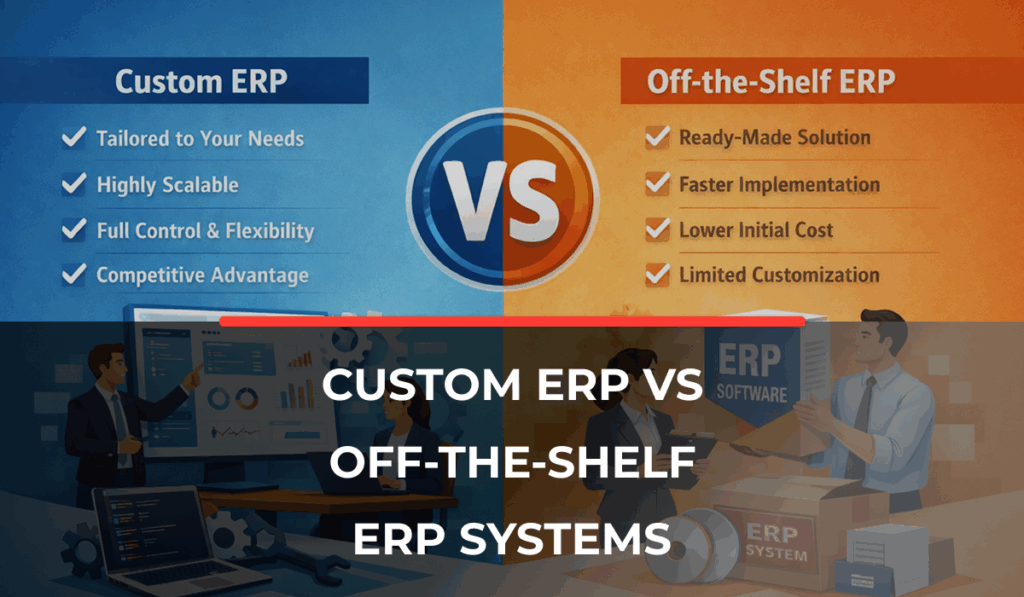
ERP systems help manage resources, streamline processes, and provide a single source of truth for data across departments. As companies grow, they also face a critical decision: should they invest in a custom ERP solution tailored to their unique workflows, or rely on a ready-made, off-the-shelf system with standard features?
A custom ERP system is built specifically for a business. It adapts to existing processes and can update as the company expands. While off-the-shelf ERP systems are pre-configured and can be deployed quickly, they may not fit all workflows perfectly.
This guide will explain the key differences between these two approaches. It will highlight considerations such as cost, flexibility, and long-term ROI. Additionally, it will touch on trends in ERP development in the UAE, across key regions, such as Dubai, Sharjah, and Abu Dhabi, to help businesses make an informed decision about what to choose.
What is a Custom ERP System?
Custom ERP software is a solution built to meet a business’s unique requirements. Unlike off-the-shelf systems, they are not one-size-fits-all products. Every module, feature, and workflow can be customized to match the company’s operations.
Custom ERP systems are mainly used across industries that require specialized operations. Logistics companies use them to manage complex supply chains and fleet operations. Healthcare organizations implement them to manage patient records, ensure regulatory compliance, and schedule resources. Recruitment agencies rely on custom ERP solutions to streamline candidate tracking, client management, and reporting.
Other sectors, including manufacturing, retail, and professional services, also benefit from customized ERP solutions. The key characteristics of custom ERP systems that set them apart from generic solutions are:
- They are designed to provide maximum flexibility, scalability, and integration with existing tools.
- Customized features that match specific business workflows, eliminating unnecessary modules.
- Scalable architecture that grows with the business, supporting expansion with no need for major redesigns.
- Integration flexibility to connect with other tools such as CRM, HR, and accounting systems, ensuring smooth data flow across departments.
What is an Off-the-Shelf ERP System?
An off-the-shelf ERP system is pre-built software meant to serve a wide range of businesses. It comes with standard features and modules that are intended to cover common business processes. These systems are ready-to-use and allow companies to implement them quickly with no need for extensive development.
Off-the-shelf ERP solutions are usually favored by small and medium-sized businesses that want to start using ERP quickly within budget. They are commonly used in industries such as retail, distribution, and service-based businesses, where standard operations can be managed efficiently with pre-built modules.
The key characteristics of an off-the-shelf ERP system include:
- Quick deployment that allows businesses to start using the system almost immediately.
- Fixed modules that provide standard functionality but limited flexibility to change workflows.
- Subscription or licensing model, often with ongoing fees for updates, support, or additional features.
Custom ERP vs Off-the-Shelf ERP: Key Differences
| Features | Custom ERP | Off-the-Shelf ERP |
|---|---|---|
| Cost | High upfront | Lower upfront |
| Customization | High flexibility | Limited |
| Deployment Time | Longer | Quick |
| Scalability | High | Moderate |
| Integration | Easy | Restricted |
| Ownership | Full | Vendor-dependent |
Advantages of Custom ERP Software
Custom ERP software offers businesses a solution built around their specific operations. Aligning directly with business workflows, it helps companies optimize processes, reduce inefficiencies, and maintain control over critical data.
1. Customized to Business Needs
Custom ERP systems fit the unique requirements of a business. They don’t ask companies to adapt their operations to standard modules. Every feature can be customized to match specific workflows.
2. No Unnecessary Features
One of the most practical advantages of custom ERP software is the elimination of unnecessary features and modules. Businesses only implement the features they actually need, avoiding clutter.
3. Scalability for Future Growth
Custom ERP solutions are built to scale alongside a business. As a company grows, new processes, departments, or operations can be integrated with no need for a complete system overhaul.
4. Grows with Business
As the architecture is flexible, custom ERP software can handle increasing data volumes, additional users, and expanding operational needs. Businesses do not need to compromise on efficiency as they expand, and updates can be implemented to match growth.
5. Better Integration Capabilities
Custom ERP systems can seamlessly integrate with existing business tools, such as CRM, HR, accounting, or inventory management systems, which ensures consistent data flow, eliminates duplicate entry, and enhances decision-making by providing a single source of truth across departments.
6. Connect with CRM, HR, and Accounting Tools
Integration flexibility allows businesses to connect specialized tools and automate workflows. For example, recruitment agencies can link candidate data from an HR system directly into the ERP, or sales teams can sync CRM data for better forecasting.
7. Competitive Advantage
Custom ERP software can provide a significant edge over competitors by enabling unique workflows and processes that off-the-shelf solutions cannot replicate. Businesses can respond faster to market change, implement innovative strategies, and maintain operational control.
8. Unique Workflows
By supporting workflows customized to the company’s specific needs, custom ERP systems allow organizations to differentiate themselves in the market. This uniqueness translates into improved efficiency, better customer service, and measurable business performance improvements.
Advantages of Off-the-Shelf ERP Systems
Off-the-shelf ERP systems provide businesses with ready-made solutions that cover essential operations with no need for extensive development. These systems are built to meet common industry requirements, which makes them a practical choice for companies that prioritize speed, cost-efficiency, and reliability.
1. Lower Initial Cost
One of the main advantages of the off-the-shelf ERP systems is their lower upfront cost. As the software is pre-built and sold to multiple businesses, companies avoid the high development expenses associated with custom solutions.
2. Faster Implementation
Off-the-shelf ERP systems can be implemented much faster than custom solutions. Businesses can start using the software within weeks or months, which depends on the complexity of their operations. Quick implementation reduces disruption and allows teams to benefit from standardized processes.
3. Proven & Tested Solutions
Pre-built ERP systems come with features that have been tested and refined across multiple industries. This reliability gives businesses confidence that the software will handle standard operations effectively.
4. Ongoing Vendor Support
Off-the-shelf ERP providers typically offer continuous support, updates, and maintenance. Businesses benefit from vendor expertise while ensuring system stability and access to new features.
Looking for Custom ERP Development in the UAE?
The right ERP solution depends on your business needs, but choosing the right development partner is just as important. Build a scalable, tailored ERP system with expert developers in the UAE.
Disadvantages of Custom ERP
- High development costs can be a significant investment for businesses.
- Longer development time compared to off-the-shelf solutions.
- Requires technical expertise to build, implement, and maintain the system effectively.
- Complexity in managing updates and adding new features as business needs change.
- Initial training and change management can be more demanding for staff.
Disadvantages of Off-the-Shelf ERP
- Limited customization, which may not fit all businesses’ workflows perfectly.
- Subscription or licensing costs that can add up over time and impact budgets.
- Feature overload or gaps are a significant disadvantage. Some modules may be unnecessary, while others may be missing.
- Vendor lock-in makes it difficult to switch providers or modify the system.
- Dependency on the vendor for updates, support, and feature enhancements.
Cost Comparison: Custom ERP vs. Off-the-Shelf ERP
Costs are one of the most important factors businesses consider when deciding between a custom ERP system and an off-the-shelf solution. While initial expenses are often higher for custom solutions, the long-term benefits, efficiency, and flexibility can justify the investment.
1. Custom ERP Cost
The cost of a custom ERP system can range from $15,000 to $100,000+, depending on the complexity of features, the number of modules, and the integrations required. Although this investment is higher upfront, it ensures that the system aligns perfectly with your business needs and eliminates unnecessary features that you would otherwise pay for in a standard package.
2. Off-the-Shelf ERP Cost
Off-the-shelf ERP systems generally involve monthly or yearly subscription fees, along with licensing costs and optional add-ons for extra modules. The pricing is predictable and lower upfront, which makes it attractive for businesses that need a working system quickly. However, adding extra functionality or expanding user capacity often incurs additional costs.
3. Long-Term Cost Analysis
Over time, the cost dynamics between custom and off-the-shelf ERP systems shift. Custom ERP involves a higher initial investment, but because it is designed for efficiency and scalability, the long-term expenses tend to be lower. There is no recurring subscription for unused features, and updates can be implemented as needed.
Related Read: How Businesses in the UAE Automate Operations with Custom Software
Custom or Off-the-Shelf? Which ERP System is Right for Your Business?
Custom and off-the-shelf ERP solutions have distinct advantages, and understanding these differences can help you make a decision that supports efficiency, scalability, and long-term success.
Choose Custom ERP If:
- You have unique workflows: Custom ERP systems are built to align perfectly with your business processes.
- You need scalability: As your business grows, your ERP system should grow with it. Custom ERP solutions allow you to add features, users, and integrations, which makes them ideal for companies planning long-term expansion.
- You want full control: Custom ERP gives you ownership over the system and its data. You can decide when and how updates are made, which integrations to include, and how features evolve.
Choose Off-the-Shelf ERP If:
- You need quick deployment: Off-the-shelf ERP solutions are pre-built and ready to use, enabling businesses to start operations with minimal setup time.
- Budget is limited: Subscription-based or licensed off-the-shelf systems typically have lower upfront costs, making them attractive for small and medium-sized enterprises that need ERP functionality with minimal investment.
- Processes are standard: If your business processes follow common patterns, an off-the-shelf ERP can handle operations efficiently. For minor tweaks or integration, companies can rely on niche software development services to complement the system.
Custom ERP Trends in the UAE
In recent years, the UAE has seen a growing shift toward customized ERP systems as businesses strive for greater efficiency, automation, and compliance. Across Dubai, Abu Dhabi, and Sharjah, companies are increasingly turning to customized enterprise resource planning platforms rather than generic solutions.
This trend reflects a broader movement in ERP development in the UAE, where businesses want systems that align with local regulatory requirements, support multi-entity operations, and accommodate complex workflows specific to their industry sectors, such as logistics, healthcare, and retail.
The UAE ERP software market was valued at approximately USD 2.14 billion, and it is projected to continue growing with an expected 8.3 % compound annual growth rate (CAGR) through 2028, driven by digital transformation initiatives, regulatory compliance requirements, and the increasing adoption of modern ERP solutions.
Studies suggest that software and implementation services in this sector will grow strongly over the next decade, driven by digital transformation initiatives, increased adoption of automation, and a move to cloud-first systems with real-time insights and AI-enabled features.
How to Choose the Right ERP Development Approach
Selecting the right ERP development approach is a critical step for businesses aiming to optimize operations and achieve long-term efficiency. The decision between a custom ERP system and an off-the-shelf solution should be guided by a thorough understanding of your business needs, growth plans, and available resources.
By following a structured approach, companies can make sure they invest in a system that aligns with their objectives, provides scalability, and delivers measurable return on investment.
Checklist for Choosing the Right ERP Development Approach:
- Clearly define your business workflows, operational needs, and required features.
- Assess how the system can scale with future growth and added users or departments.
- Compare upfront costs with long-term savings and overall ROI.
- Work with an experienced ERP vendor or team offering ERP development in the UAE and niche software development services.
Conclusion
This guide compares custom ERP software with off-the-shelf ERP systems, highlighting differences in cost, flexibility, scalability, and integration capabilities. Custom ERP offers tailored workflows, full control, and long-term scalability, making it ideal for businesses with unique operations or ambitious growth plans.
Off-the-shelf ERP provides quicker deployment, lower upfront costs, and proven features, suiting companies with standard processes and tighter budgets.
Ultimately, the best approach depends on your business requirements, growth strategy, and operational priorities. Make sure to invest in the right ERP solution to ensure smoother workflows, better integration, and measurable efficiency gains over time.
Ready to Transform Your Business with a Custom ERP?
Book a free consultation today with an expert in the field to discuss your requirements and see how a custom ERP system can help your business grow.
FAQs
What is custom ERP software?
Custom ERP software is a system built to match the unique workflows and operational needs of a business. It is built from the ground up to include only the modules and features a company requires.
What is the difference between custom ERP and off-the-shelf ERP?
Custom ERP is fully customized to a company’s processes, offering complete flexibility, scalability, and control over features. Off-the-shelf ERP comes with pre-built modules that are ready to use but offer limited customization.
Which ERP is more cost-effective?
The cost-effectiveness depends on long-term goals. Custom ERP involves higher upfront costs ($15,000 to $100,000+) but reduces long-term expenses. Off-the-shelf ERP has lower initial costs through subscription or licensing, but can become expensive over time due to ongoing fees, add-ons, and limited flexibility.
How long does it take to build a custom ERP system?
The timeline varies based on complexity, number of modules, and integrations. Simple custom ERP systems can take 3 to 6 months, while more complex platforms require 9 to 12 months or longer.
Is custom ERP worth it for small businesses?
Yes, if the business has specific workflows, plans to scale, or needs integration with other systems. Even small businesses benefit from tailored solutions that reduce inefficiencies and improve decision-making.
Do you offer ERP custom software development services in the UAE?
Yes, we provide ERP custom software development services across the UAE. Avail our ERP software development services in Abu Dhabi, Sharjah, Dubai, and across the UAE. Our solutions are tailored to your business needs and are designed to improve efficiency, scalability, and long-term performance.
How do I choose the right ERP software development company in Sharjah?
Choosing the right ERP software development company in Sharjah depends on factors such as experience, industry expertise, customization capabilities, and post-launch support. It’s important to work with a team that understands your business processes and can deliver scalable solutions.