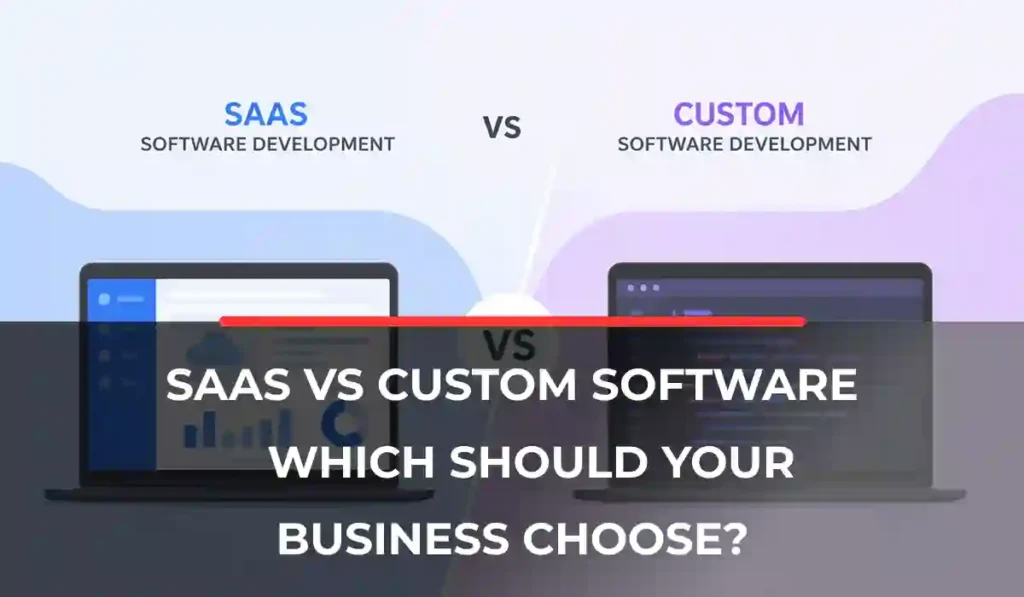
Businesses today rely heavily on software for daily operations. Companies use it for sales, accounts, HR, customer support, and other operational tasks, which is why they now compare SaaS platforms with custom software development services before making a decision.
What is the difference between SaaS and custom software? SaaS is ready to use (one size fits all). Users can purchase pre-made software from a vendor, usually on a monthly subscription. Think Salesforce.
On the other hand, custom software is built for specific business needs and gives users more control and flexibility. You can handpick the features, workflows, and processes for greater efficiency.
The right software can affect business growth, work efficiency, and long-term costs. This guide explains SaaS vs custom software, their benefits, limitations, costs, and which option may work better for different businesses.
What Is SaaS?
SaaS stands for Software as a Service. It is software that companies use through the internet instead of installing it on company systems. Most SaaS platforms work on monthly or yearly subscription plans.
The software provider manages hosting, updates, maintenance, and security. Businesses can access the platform from different devices using an internet connection. As a result, many companies invest in SaaS application development to create scalable and easily accessible software products.
Common Examples of SaaS Applications
Many businesses use SaaS applications because they are simple to start and easy to manage. Some common examples include:
- CRM software for managing customers and sales activities.
- Project management tools for task tracking and team communication.
- Accounting software for invoices, expenses, and financial records.
- HR management platforms for employee management, payroll, and attendance tracking.
What Is Custom Software?
Custom software is software built for specific business needs. Unlike ready-made SaaS products, custom software is designed based on a company’s workflows, operations, and goals. Companies usually choose custom solutions when standard software cannot fully support their requirements.
Custom software development involves planning, designing, developing, testing, and launching software based on business needs. Companies work with custom software development services to build systems that match their processes, integrations, and future scalability plans.
Examples of Custom Business Software
Different industries use custom software for different operations. Some common examples include:
- Custom ERP systems for managing business operations and resources.
- Industry-specific management platforms for healthcare, logistics, retail, or real estate businesses.
- Custom mobile apps for customer services, bookings, or internal operations.
- Workflow automation systems for reducing manual tasks and improving efficiency.
SaaS vs Custom Software: Key Differences
SaaS and custom software both help businesses manage operations and improve efficiency. However, they are different in many areas, such as control, customization, scalability, and long-term flexibility.
Ownership & Control
SaaS is owned and managed by the software provider. Businesses use the platform through a subscription plan, but do not fully control the system or data infrastructure.
Custom software gives users full ownership and control. Companies can decide how the software works, how data is managed, and what features should be added in the future.
Customization Capabilities
SaaS platforms usually offer limited customization. Businesses can change basic settings, but major modifications are often restricted. Custom software is built around specific business processes. This makes it easier to add custom features, workflows, and integrations based on operational needs.
Scalability
SaaS platforms can support business growth, especially for small and medium-sized companies. However, some users may face limitations when operations become more complex. Custom software offers better long-term scalability because the system can grow with the business. New modules, users, and features can be added when needed.
Integration Flexibility
Many SaaS tools support third-party integrations, but compatibility can sometimes become a challenge with older systems or unique workflows. Custom software provides more integration flexibility. Businesses can connect the software with internal systems, ERP platforms, payment gateways, or external tools more easily.
Security & Compliance
SaaS providers usually manage platform security and regular updates. This works well for many organizations, but companies may have limited control over data handling practices.
Custom software allows users to build security features based on industry requirements and compliance standards. This is important for industries with strict data regulations.
Deployment Time
SaaS is faster to deploy because the platform is already built and ready to use. Businesses can often start within a few days. Custom software takes more time because the system must be designed, developed, tested, and deployed based on business requirements.
Maintenance & Support
SaaS providers handle maintenance, updates, and technical support as part of the subscription service. With custom software, businesses manage maintenance either internally or through a custom software development services provider.
| Features | SaaS | Custom Software |
|---|---|---|
| Ownership | Managed by the provider | Fully owned by the business |
| Customization | Limited | High flexibility |
| Scalability | Good for standard growth | Better for long-term scaling |
| Integrations | Limited in some cases | Highly flexible |
| Security Control | Provider-managed | Business-controlled |
| Deployment Time | Fast | Longer development time |
| Maintenance | Managed by the provider | Managed by a business or development partner |
Not Sure Which Solution Fits Your Business?
Choosing between SaaS and custom software depends on your workflows, growth plans, and long-term goals. Speak with our experts to explore the best approach for your business.
Benefits of SaaS
Many businesses choose SaaS because it is simple to use, faster to launch, and requires a lower initial investment. It is commonly used by startups, SMEs, and companies that need quick software solutions without complex setup.
- Lower Upfront Costs: SaaS platforms usually do not require large development costs. Businesses pay monthly or yearly subscription fees instead of investing heavily at the beginning.
- Faster Deployment: Most SaaS platforms are ready to use. Companies can start using the software quickly without long development timelines.
- Easy Accessibility: Users can access SaaS from different devices and locations through the internet. This helps remote teams and multi-location businesses work more efficiently.
- Automatic Updates & Maintenance: The software provider handles updates, bug fixes, security patches, and maintenance. Businesses do not need to manage technical updates internally.
- Subscription-Based Pricing: SaaS usually works on flexible subscription plans. Businesses can choose packages based on users, features, or operational needs.
Limitations of SaaS
SaaS is useful for many businesses, but it also has some limits. These limits can affect control, flexibility, and long-term use depending on business needs.
- Limited Customization: Most SaaS platforms offer fixed features. Businesses can adjust settings, but big changes in design or workflow are usually not possible.
- Vendor Dependency: Companies depend on the SaaS provider for uptime, updates, and support. Any issue on the provider side can affect business operations.
- Ongoing Subscription Costs: SaaS works on recurring payments. Over time, subscription fees can become higher than expected, especially for growing teams.
- Data Security Concerns: Data is stored on external servers managed by the provider. Some businesses may have concerns about data control and privacy.
- Integration Challenges: Some SaaS tools do not connect smoothly with internal systems or other software, which can create workflow gaps.
Benefits of Custom Software
Custom software is chosen by businesses that need more control and flexibility in how their systems work. It is built around specific business processes and long-term goals.
- Tailored to Business Processes: Custom software is designed based on how a business actually works. This helps teams follow their real workflows without adjusting to fixed system rules.
- Greater Scalability: The system can grow with the business. New features, users, and modules can be added when operations expand.
- Enhanced Security & Compliance: Businesses can build security based on their own requirements. This is useful for industries with strict data protection rules.
- Competitive Advantage: Custom solutions can include unique features that competitors do not have. This helps improve efficiency and customer experience.
- Long-Term Flexibility: The software can be updated or changed anytime as business needs evolve. There are no restrictions from external providers.
Limitations of Custom Software
Custom software gives more control, but it also comes with some challenges. Businesses should understand these before choosing it.
- Higher Initial Investment: Custom software needs planning, design, and development from scratch. This makes the starting cost higher compared to SaaS platforms.
- Longer Development Timeline: The process takes time because everything is built based on business requirements. It can take weeks or months to complete.
- Ongoing Maintenance Responsibility: Businesses need to handle updates, bug fixes, and system improvements either internally or through a development partner.
- Requirement for Technical Expertise: Managing custom software often needs technical knowledge. Companies may need skilled developers or a software partner for support.
SaaS vs Custom Software Cost Comparison
Cost is one of the main factors businesses consider when choosing between SaaS and custom software. Both options have different pricing structures and long-term financial impacts.
Initial Development & Setup Costs
SaaS has a very low setup cost. Businesses only need to pay subscription fees to start using the platform. Custom software needs a higher initial investment. Costs include planning, design, development, and testing before launch.
Long-Term Operational Costs
SaaS has predictable monthly or yearly costs. However, these costs continue as long as the business uses the platform. Custom software may have lower long-term costs after development, but it still requires a budget for maintenance and updates.
Licensing & Subscription Expenses
SaaS platforms use subscription-based pricing. Businesses pay based on users, features, or usage levels. Custom software does not require licensing fees. Once developed, there is no recurring subscription to a third-party provider.
Maintenance & Upgrade Costs
SaaS maintenance is handled by the provider and included in the subscription fee. Custom software requires separate maintenance. Businesses either hire a team or work with custom software development services for upgrades and support.
| Cost Factor | SaaS | Custom Software |
|---|---|---|
| Initial Setup Cost | Low | High |
| Development Cost | None | High |
| Subscription Fees | Monthly/Yearly | None |
| Maintenance Cost | Included in plan | Separate expense |
| Long-Term Cost | Continuous payments | Lower after development |
| Upgrade Cost | Provider-managed | Business-controlled |
When Should Businesses Choose SaaS?
SaaS is suitable when a business has a limited budget or wants to avoid high upfront costs. Rather than large development spending, companies pay small monthly or yearly fees, which makes cost management easier, especially in the early stages.
It is also preferred when quick deployment is needed. SaaS works well when business processes are standard and do not require deep customization. Common functions like sales tracking, accounting, or HR tasks can be handled smoothly.
Small teams and startups usually go with SaaS because it is easy to manage. It reduces technical effort and allows teams to focus more on growth and daily operations.
When Should Businesses Choose Custom Software?
Custom software is a better option when a business has unique requirements that standard SaaS tools cannot fully support. It allows companies to build systems based on their own workflows instead of adjusting operations to fit a fixed platform.
It also fits well for complex workflows and operations where multiple teams or systems need to work together in a specific way. In such cases, custom solutions provide better control and smoother process flow.
Businesses with long-term scalability plans often choose custom software. The system can grow over time, and new features can be added as the business expands. Companies gain greater control over their data, improving security and reducing dependency on third-party providers.
It is especially useful in industries with strict compliance needs. Custom software can be built to match specific regulations and security standards.
How to Decide Between SaaS & Custom Software
Choosing between SaaS and custom software depends on operational needs, growth plans, and long-term goals. A clear understanding of goals, budget, and operations helps in making the right decision.
Evaluate Your Business Goals
Start by looking at what the business wants to achieve. If the goal is quick setup and basic features, SaaS may be enough. If the goal is full control and unique workflows, custom software is a better fit.
Assess Budget & Timeline
Budget and time are key factors. SaaS works well for lower budgets and fast launch needs. Custom software needs higher investment and more time but offers long-term value.
Consider Scalability Requirements
Think about future growth. SaaS can support standard scaling, but custom software gives more flexibility when the business expands or changes operations.
Analyze Integration Needs
Check how the software will connect with other systems. SaaS may have limited integration options, while custom software can be built to connect with any internal or external tools.
Think About Long-Term ROI
Long-term value is important. SaaS has ongoing subscription costs, while custom software has a higher upfront cost but can become more cost-effective over time, depending on usage and scale.
Hybrid Approach: Combining SaaS & Custom Software
A hybrid approach means using both SaaS and custom software together in one business system. Many companies use this model when they need speed from SaaS but also need control and flexibility from custom solutions. It helps balance cost, time, and functionality.
Combining both models makes sense when a business already uses SaaS tools for common tasks but still has specific needs that cannot be covered by those tools. It is also useful when companies want to avoid building everything from scratch but still need some level of customization.
For example, a company may use SaaS for accounting or email management, while using custom software for core operations like order management or internal workflows.
Another example is using SaaS CRM tools with a custom-built dashboard that connects all business data in one place.
The main benefit of this approach is flexibility. Businesses can reduce development time by using SaaS where possible and still get customized features through custom software.
Conclusion
SaaS and custom software both help businesses manage operations, but they work in different ways. SaaS is quick to use, low in upfront cost, and good for standard business needs. Custom software gives full control, better flexibility, and stronger long-term scalability.
The right choice depends on business size, goals, budget, and how complex the operations are. Some businesses need fast solutions, while others need systems built for long-term growth and unique processes.
Ready to Choose the Right Software Solution for Your Business?
Whether you need a ready-to-launch SaaS platform or a fully customized business solution, our team can help you build software that supports your operations, scalability, and long-term growth.
FAQs
What is the difference between SaaS and custom software?
SaaS is ready-made software that you use through the internet on a subscription. Custom software is built from scratch based on a business’s specific needs and processes.
When should a business choose custom software?
A business should choose custom software when it has unique processes, complex workflows, or needs features that SaaS tools cannot provide.
Is custom software better for scaling businesses?
Yes, in many cases. Custom software can be designed to grow with the business and support new features, users, and workflows over time.
Can startups use custom software?
Yes, startups can use custom software, but it depends on their budget and needs. Many startups start with SaaS and move to custom solutions later.
How do businesses decide between SaaS and custom solutions?
Businesses decide based on budget, timeline, scalability needs, and complexity of operations. SaaS works well for simple and immediate needs, while custom software is better suited for long-term and complex requirements.