In 2026, the Central Bank of the UAE (CBUAE) aims to maintain a favorable environment for the country’s insurance industry. The insurance industry relies on strong customer relationships, timely communication, and efficient policy management. Unlike many countries where insurance is primarily a financial product, insurance in the UAE is closely linked to residency, visas, healthcare compliance, and government regulations.
These factors require insurers to manage customer data, regulatory compliance, and policy administration efficiently while adhering to the Insurance Core Principles (ICPs) established by the International Association of Insurance Supervisors (IAIS). Despite this, many insurance agencies and brokers still struggle with disconnected systems, manual processes, and fragmented customer data, which impact both productivity and client satisfaction.
A custom Customer Relationship Management (CRM) system designed for insurance companies centralizes customer information, streamlines sales and service workflows, automates follow-ups, provides valuable insights, supports visa-linked insurance verification, and simplifies regulatory reporting to the Central Bank (CBUAE).
Whether you’re a startup insurance agency or an established insurance provider, choosing the right CRM can improve client retention, increase policy renewals, and help your team close more business.
This guide explains what an insurance CRM is, how a custom insurance CRM helps in the UAE, its essential features, benefits, implementation considerations, and how to choose the best solution for your business.
By the end of this guide, you’ll understand how CRM systems transform insurance operations, which features matter most, and how to select a CRM that supports long-term growth.
What Is a CRM System for Insurance Companies?
CRM stands for Customer Relationship Management. It is a technology used to organize, track, and improve interactions with customers throughout their relationship with a company.
What Is an Insurance CRM?
An Insurance CRM (Customer Relationship Management) system is software that helps insurance companies manage customer information, interactions, policies, leads, claims, and services from one centralized platform. An insurance CRM helps insurers not only generate leads and manage customers but also streamline policy sales, renewals, claims management, customer onboarding, email campaigns, customer support, and automated policy updates based on regional requirements.
How Insurance CRMs Differ from Generic CRM Software
Unlike a generic CRM that mainly tracks leads and customer communications, an insurance CRM manages the entire policy lifecycle, including policy creation, underwriting, endorsements, renewals, cancellations, and policy updates. Moreover, many UAE-specific regulatory requirements are not fully supported by generic CRMs such as Zoho CRM or Salesforce without customization.
- CBUAE’s strict reporting format,
- 5% VAT handling, including the separation of VAT-exempt and taxable transactions,
- Arabic-Englishpolicy documents, SMS, emails,
- RTL Arabic interfaces.
- Islamic insurance (Takaful)follows different operational and financial principles from conventional insurance.
- Abu Dhabi (Daman, Thiqa), Dubai (DHA E-Naya), and Sharjah have different rules.
- WPS salary system
Who Uses an Insurance CRM?
An Insurance CRM is used by a wide range of organizations and professionals across the insurance industry.
- Insurance agencies use it to manage customer relationships, policies, and renewals.
- Insurance brokers rely on it to handle multiple insurance providers, track client requirements, and manage commissions.
- Car insurance providers use CRM systems to process quotes, policy issuance, claims, and renewal reminders.
- Health insurance companies leverage CRM platforms to manage member information, healthcare plans, compliance requirements, and customer support.
- Life insurance companies use CRM solutions to track long-term customer relationships, policy servicing, beneficiary information, and premium payments.
- Commercial insurance firms depend on CRM systems to manage complex business policies, risk assessments, and corporate client accounts.
- Independent insurance agents also use Insurance CRMs to organize leads, automate follow-ups, maintain customer records, and provide personalized service while growing their client base.
Why Insurance Companies Need a CRM
Insurance isn’t a “sell once and forget” business. It’s a relationship that lasts 12 months, 5 years, or even 20 years. Insurance companies handle thousands of policyholders, beneficiaries, and prospects; that’s why generic CRMs fails here to manage such large and region-specific data.
1. Managing Customer Relationships
An insurance CRM helps companies build stronger and longer-lasting relationships with customers by providing a 360-degree view of every interaction and policy in compliance with specific locations.
Complete Policyholder History
Stores all customer information, active and expired policies, documents, claims, communications, endorsements, and service requests in one place for easy access.
Personalized Insurance Communication
Allows insurers to send relevant offers, renewal reminders, updates, coverage limits, and claim status based on customer needs and preferences.
Stronger Policyholder Retention
Helps maintain regular communication with customers, improving satisfaction, trust, and retention.
2. Improving Sales Performance
Insurance sales involve multiple quotes, underwriting reviews, and follow-ups. An insurance CRM helps agents and brokers manage these activities more efficiently and close more policies.
Insurance Lead Management
Captures leads from websites, brokers, referral partners, and marketing campaigns and automatically assigns them to the appropriate agent.
Opportunity Tracking
Tracks insurance quotations, underwriting progress, customer responses, and conversion rates from inquiry to policy issuance.
Sales Pipeline Visibility
Provides real-time visibility into pending quotes, policy applications, renewals, and sales performance across teams and branches.
Cross-Selling and Upselling Opportunities
Identifies customers who may benefit from additional coverage, such as life, health, motor, travel, or property insurance policies.
3. Streamlining Policy Management
Managing policies efficiently is one of the most important functions of an insurance company. An insurance CRM helps automate and organize policy-related processes from issuance to renewal.
Automated Policy Renewals
Monitors policy expiration dates and automatically initiates renewal workflows to minimize policy lapses.
Renewal and Expiration Alerts
Sends reminders to policyholders, agents, and brokers before policies expire, helping improve renewal rates.
Insurance Document Management
Stores policy certificates, claim documents, customer identification records, underwriting reports, and compliance documents in a centralized repository.
Policy Amendments and Endorsements
Tracks coverage modifications, beneficiary changes, endorsements, and other policy updates throughout the policy term.
4. Enhancing Customer Service
Customer service is critical in insurance, especially during claims and policy servicing. An insurance CRM helps teams deliver faster, more informed, and more consistent support.
Faster Claims and Service Responses
Provides instant access to policy details, claims history, coverage information, and customer records, reducing response times.
Centralized Policyholder Information
Brings together policy, claims, billing, communication, and customer data within a single platform for a complete customer view.
Consistent Multi-Channel Communication
Ensures customers receive accurate updates regarding claims, renewals, policy changes, and service requests across email, phone, portals, and mobile apps.
Improved Claims Resolution
Allows service teams to track claim status, required documents, approvals, and customer communications, resulting in faster and more transparent claim handling.
Key Features of CRM Systems for Insurance Companies
Contact & Customer Management
- Centralized customer and policyholder profiles
- Complete interaction and communication history
- Household and family coverage management
- Customer preferences and communication tracking
- Policy ownership and beneficiary information
- Claims and service request history
- Unified 360-degree customer view
Lead Management
- Lead capture from websites, brokers, referrals, and campaigns
- Automatic lead assignment to agents
- Lead scoring and qualification
- Follow-up reminders and task scheduling
- Quote request management
- Sales opportunity tracking
- Lead-to-policy conversion tracking
Policy Management
- Active and expired policy management
- Automated policy renewal tracking
- Coverage and endorsement history
- Premium and payment tracking
- Policy issuance and updates
- Policy cancellation and reinstatement management
- Policy expiration alerts and notifications
Claims Tracking
- Real-time claim status monitoring
- Claims registration and intake management
- Document and evidence storage
- Customer communication tracking
- Claims approval workflow management
- Settlement and payout tracking
- Claims history and reporting
Workflow Automation
- Automated email and SMS notifications
- Policy renewal and expiration alerts
- Task and activity reminders
- Follow-up scheduling for agents
- Automated lead assignment
Reporting & Analytics
- Sales performance reports
- Policy renewal rate analysis
- Customer retention tracking
- Agent and broker performance monitoring
- Claims trend and settlement reports
- Revenue and premium dashboards
- Custom business intelligence reports
Document Management
- Centralized policy document repository
- Claims file management
- Contract and agreement storage
- KYC and compliance document management
- Version control and audit trails
- Digital signature integration
- Secure document sharing and access controls
Mobile CRM Access
- Remote access to customer records
- Mobile lead and opportunity management
- Policy and renewal updates
- Claims status tracking from mobile devices
- Real-time notifications and alerts
- Productivity tools
- Customer visit notes and activity logging
Benefits of Using CRM Software in the Insurance Industry
For UAE insurance companies that still rely on spreadsheets, email chains, disconnected policy systems, legacy software, or separate databases, the value of an insurance CRM becomes most visible when addressing operational inefficiencies that affect growth, compliance, and customer experience.
Improved Customer Retention
A CRM consolidates policyholder data into a single view, thus helping insurers proactively manage renewals, policy servicing, and customer engagement. See how CRM Systems Improve Sales Pipeline Management | Complete Guide.
Better Agent Productivity
By centralizing customer, policy, and claims information, a CRM reduces manual work and enables agents to focus more on sales and customer service.
Increased Policy Renewals
Automated renewal reminders and policy expiration alerts help insurers reduce policy lapses and improve renewal rates.
Faster Claims Processing
A CRM streamlines claims tracking, document management, and customer communications, helping resolve claims more efficiently.
Enhanced Regulatory Compliance
CRM software helps insurers maintain accurate records, audit trails, and compliance documentation to meet UAE regulatory requirements.
Better Data Visibility
Real-time dashboards provide insights into policies, claims, sales performance, and customer activity from a single platform.
Improved Cross-Selling Opportunities
A unified customer view helps agents identify opportunities to offer additional insurance products based on customer needs.
Reduced Operational Costs
Workflow automation minimizes manual tasks, duplicate data entry, and administrative overhead, improving operational efficiency. See how much it costs to build a Custom CRM System in the UAE.
Stronger Broker and Agent Collaboration
A centralized system enables brokers, agents, and internal teams to work with the same customer and policy information.
Scalable Growth and Digital Transformation
A CRM provides the foundation for digital operations, supporting business growth, automation, and improved customer experiences.
Looking For A CRM Tailored To Your Insurance Business?
Our CRM specialists build customized insurance CRM solutions that simplify customer management, automate workflows, and support business growth.
Essential Integrations for Insurance CRM Systems
When developing a CRM for an insurance company, seamless integration with existing business systems is critical. These integrations help eliminate data silos, automate workflows, and improve operational efficiency.
Policy Management Systems
Integrates with policy administration platforms to synchronize policy issuance, renewals, endorsements, cancellations, coverage details, and claims information in real time.
Accounting Software
Examples: QuickBooks, Xero
Connects financial data with the CRM to automate premium tracking, invoicing, commissions, reconciliations, and financial reporting.
Email Platforms
Examples: Outlook, Gmail
Allows agents to send emails, manage customer communications, schedule meetings, and automatically log email conversations within customer records.
Communication Tools
Examples: Twilio, Zoom, Microsoft Teams
Enables voice calls, SMS notifications, video meetings, claim discussions, and customer support interactions directly from the CRM.
Payment Gateways
Supports secure premium payments, recurring billing, payment reminders, transaction tracking, and automated payment confirmations for policyholders.
Marketing Automation Platforms
Examples: HubSpot, Mailchimp
Helps insurers automate email campaigns, renewal reminders, customer engagement programs, lead nurturing, and cross-selling initiatives based on customer data.
CRM Workflow for an Insurance Company
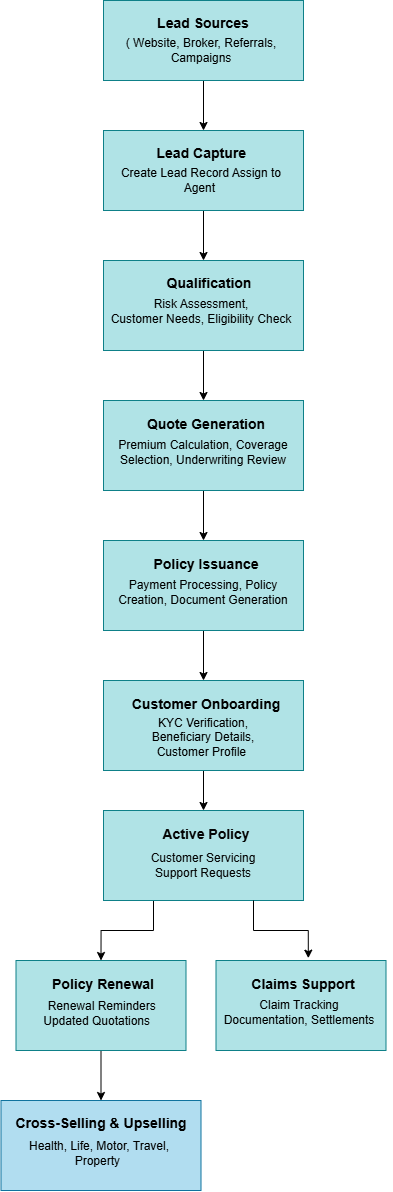
An insurance CRM manages the complete customer journey, from capturing a lead to policy renewal and cross-selling opportunities. It connects sales, underwriting, policy administration, claims, customer service, and marketing teams within a single platform.
Common Challenges Faced by Insurance Companies Without a CRM
Many companies rely on legacy systems. As the business grows, these outdated processes can lead to inefficiencies, missed opportunities, and poor customer experiences. A modern insurance CRM helps eliminate these challenges by centralizing data, automating workflows, and providing complete visibility across the insurance lifecycle.
Lost Customer Information
Customer data is often scattered across spreadsheets, emails, and multiple systems, making it difficult to access complete policyholder information. A CRM centralizes all customer, policy, and claims records in one platform.
Missed Policy Renewals
Manual tracking can result in overlooked renewal dates and lost revenue opportunities. A CRM automatically monitors policy expirations and sends renewal reminders to both agents and customers.
Manual Data Entry
Insurance teams spend significant time entering the same information into multiple systems, increasing the risk of errors. A CRM automates data capture and reduces duplicate data entry.
Poor Agent Collaboration
Sales agents, brokers, claims teams, and customer service representatives often work with separate information sources. A CRM provides a shared workspace with real-time access to customer and policy data.
Limited Sales Visibility
Without a centralized system, managers struggle to track leads, quotes, and sales performance. A CRM offers dashboards and reports that provide complete visibility into the sales pipeline.
Slow Customer Response Times
Agents may need to search through multiple systems to find customer information. A CRM provides instant access to policy details, claims history, and communications, enabling faster responses.
Difficulty Tracking Claims
Claims information can become fragmented across emails, documents, and departments. A CRM centralizes claim records, status updates, documents, and customer communications for efficient claims management.
Custom Insurance CRM vs Off-the-Shelf CRM
Choosing between a custom insurance CRM and an off-the-shelf CRM depends on your company’s processes, growth plans, regulatory requirements, and technology landscape. While off-the-shelf solutions offer a faster implementation path, custom insurance CRMs provide greater flexibility for insurers with unique workflows, integrations, and compliance needs. Here’s a quick overview of the benefits of each option and when it’s most appropriate.
Off-the-Shelf CRM
Off-the-shelf CRM solutions such as Salesforce, Microsoft Dynamics 365, Zoho CRM, and HubSpot provide pre-built features that can be deployed quickly with minimal development effort.
Advantages
- Faster implementation and deployment
- Lower upfront development costs
- Proven functionality and vendor support
- Regular updates and security enhancements
- Suitable for standard insurance processes
Limitations
- Limited customization for unique insurance workflows
- May require workarounds for underwriting and claims processes
- Additional licensing costs as users grow
- Integration limitations with legacy insurance systems
- Less control over platform functionality
Custom CRM
A custom insurance CRM is built specifically around the insurer’s business processes, products, compliance requirements, and operational workflows.
Advantages
- Tailored to insurance-specific processes
- Custom policy, claims, and renewal workflows
- Seamless integration with existing systems
- Greater flexibility and scalability
- Full ownership of features and functionality
Challenges
- Higher initial development investment
- Longer implementation timeline
- Ongoing maintenance and support responsibilities
- Requires skilled development resources
- Project scope must be carefully managed
Which Option Is Right for Your Business?
The right choice depends on your organization’s size, operational complexity, and long-term goals. Smaller agencies may benefit from a ready-made CRM, while growing insurers with complex processes often require a customized solution that aligns with their business model.
| Factor | Off-the-Shelf CRM | Custom Insurance CRM |
|---|---|---|
| Business Size | Best for startups, brokers, and small agencies | Best for mid-sized and large insurers |
| Budget | Lower upfront investment | Higher initial investment |
| Scalability | Scales within vendor limitations | Built to support specific growth requirements |
| Customization | Limited to available features and configurations | Fully tailored to business processes |
| Integration Requirements | Supports common integrations | Can integrate with any internal or third-party system |
| Policy Management | May require customization | Designed around policy workflows |
| Claims Management | Often requires add-ons or external systems | Built specifically for claims processes |
| Regulatory Compliance | General compliance features | Customized for UAE insurance regulations and reporting |
| Data Ownership | Dependent on the vendor platform | Full control over data and functionality |
| Implementation Time | Weeks to months | Months, depending on project scope |
Final Thoughts:
An off-the-shelf CRM is ideal for insurance businesses seeking a quick and cost-effective solution. A custom insurance CRM is better suited for organizations that require specialized policy management, claims workflows, regulatory compliance capabilities, and deep integration with existing insurance systems.
How to Choose the Best CRM for Your Insurance Company
Identify Your Business Needs
- Define your primary business goals for implementing a CRM
- Identify current operational challenges and bottlenecks
- List departments that will use the CRM (sales, underwriting, claims, customer service, brokers)
- Determine the number of users and expected growth
- Document key insurance processes that need automation
- Identify reporting and compliance requirements
Evaluate Industry-Specific Features
- Supports policy lifecycle management
- Includes renewal tracking and automated reminders
- Supports quote generation and policy issuance
- Stores insurance documents and compliance records
Consider Scalability
- Can support future business growth
- Handles increasing customer and policy volumes
- Supports multiple branches or business units
- Accommodates growing agent and broker networks
- Provides flexible user licensing options
Check Integration Capabilities
- Connects with accounting software (QuickBooks, Xero, ERP)
- Supports email platforms (Outlook, Gmail)
- Integrates with payment gateways
- Connects with communication tools (Twilio, Teams, Zoom)
- Supports API-based third-party integrations
- Integrates with document management systems
Assess Data Security
- Data encryption at rest and in transit
- Compliance with UAE data protection requirements
- Secure document storage and sharing
- Multi-factor authentication (MFA) support
Evaluate Vendor Support
- Dedicated implementation support
- Insurance industry experience
- Service Level Agreements (SLAs)
- Product update and maintenance roadmap
- Customer references and case studies
Compare Pricing Models
- Initial implementation costs
- Monthly or annual subscription fees
- Customization and development costs
- Integration expenses
- Ongoing support and maintenance fees
- Future upgrade and scalability costs
CRM Implementation Best Practices
Successful CRM implementation requires clear planning, clean data, user adoption, and continuous improvement to maximize business value and ROI.
Define Business Goals
- Set clear objectives and success metrics
- Align CRM features with business needs
Clean Existing Data
- Remove duplicate and outdated records
- Standardize customer and policy data before migration
Train Employees
- Provide role-based CRM training
- Encourage user adoption from day one
Automate Core Workflows
- Automate renewals, follow-ups, claims updates, and notifications
- Reduce manual tasks and errors
Monitor Performance Metrics
- Track sales, renewals, claims, and customer retention
- Measure CRM adoption and productivity gains
Continuously Optimize Your CRM
- Gather user feedback regularly
- Improve workflows, reports, and integrations over time
| Mistake | How to Avoid It |
|---|---|
| Unclear business objectives | Define goals before implementation. |
| Poor data quality | Clean and validate data before migration. |
| Insufficient user training | Provide ongoing training and support. |
| Over-customization | Start simple and scale gradually. |
| Ignoring integrations | Plan system integrations early. |
| Lack of performance tracking | Monitor KPIs and CRM usage regularly. |
Future Trends in Insurance CRM Systems
The future of insurance CRM is focused on automation, data intelligence, and personalized customer experiences. These innovations help insurers improve efficiency, reduce costs, and deliver faster service.
AI-Powered Customer Insights
AI analyzes customer behavior, policy history, and interactions to help insurers deliver personalized recommendations and improve customer retention.
Predictive Analytics
Advanced analytics helps insurers predict policy renewals, customer churn, fraud risks, and cross-selling opportunities before they occur.
Automated Claims Assistance
AI-powered systems automate claim intake, document verification, and claim status updates, reducing processing times and operational workload.
Intelligent Chatbots
Chatbots provide 24/7 support for policy inquiries, claims tracking, renewal questions, and customer service requests without human intervention.
Omnichannel Customer Engagement
Modern CRMs unify customer interactions across email, phone, web portals, mobile apps, social media, and messaging platforms for a seamless experience.
Mobile-First CRM
Mobile CRM solutions enable agents, brokers, and field teams to access customer, policy, and claims information anytime and anywhere.
Cloud-Based CRM Platforms
Cloud CRM platforms offer greater scalability, lower infrastructure costs, faster deployments, real-time access, and easier integration with insurance systems.
Why the Right CRM Improves Insurance Business Growth
The right insurance CRM helps insurers streamline operations, improve customer relationships, and make data-driven decisions that directly contribute to business growth and profitability.
Better Customer Experience
A CRM provides agents with complete customer, policy, and claims information, enabling faster service, personalized communication, and a smoother customer journey.
Increased Revenue
Automated lead management, renewal tracking, and cross-selling opportunities help insurers generate more policies, improve renewal rates, and increase revenue.
Improved Operational Efficiency
Workflow automation reduces manual tasks, data duplication, and administrative workload, allowing teams to handle more customers with fewer resources.
Stronger Customer Loyalty
Proactive communication, timely renewals, and personalized service improve customer satisfaction and encourage long-term policyholder relationships.
Smarter Business Decisions
Real-time dashboards and analytics provide insights into sales performance, claims trends, customer behavior, and business growth, helping leaders make informed decisions.
Explore the Top CRM Development Companies in the UAE: 2026 Expert Guide
Transform Your Insurance Operations with the Right CRM
Managing customer relationships, policies, claims, and renewals becomes significantly easier with a CRM designed for the insurance industry.
Our CRM development experts build scalable, secure, and fully customized CRM solutions that help insurance companies improve customer satisfaction, streamline operations, and drive long-term growth.
Looking for a CRM Built for Insurance Companies?
Whether you’re relying on spreadsheets, disconnected systems, or an outdated CRM, we build custom insurance CRM solutions that streamline operations, automate policy management, improve customer experiences, and support long-term business growth.