Construction companies manage many activities every day. They need to estimate project costs, purchase materials, manage subcontractors, track equipment, schedule workers, process payroll, and complete projects on time.
When these tasks are managed using spreadsheets or separate software, mistakes become more common. Teams spend more time searching for information, projects fall behind schedule, and costs become harder to control.
Office staff, project managers, site engineers, accountants, and field workers all need access to the same accurate information. This is where a construction ERP system becomes valuable. An Enterprise Resource Planning (ERP) system brings important business functions into one platform. It connects project management, accounting, procurement, inventory, equipment management, payroll, customer management, and reporting.
In this guide, you will learn what a construction ERP system is, how it works, the benefits it offers, the features to look for, implementation best practices, and whether a ready-made or custom ERP solution is the right choice for your business.
What Is a Construction ERP System?
A construction ERP system is a business management solution specifically for construction companies. ERP stands for Enterprise Resource Planning. It is software that helps businesses manage and connect their core operations through one integrated system.
For construction companies, an ERP system goes beyond basic accounting or project management. It combines multiple business functions into one platform, so information flows automatically between departments. For example, when materials are purchased for a project, the ERP system can automatically update inventory levels, record expenses, adjust the project budget, and notify the finance team.
As every construction company has different workflows, many businesses eventually invest in custom ERP development services to build ERP solutions that match their operations instead of changing their processes to fit standard software.
How Construction ERP Systems Work
A construction ERP system stores all business information in a centralized database that every authorized department can access. When information is updated by one team, it becomes available across the entire organization in real time.
Most modern ERP systems are cloud-based, which allows project managers, engineers, office staff, and field workers to access important information from almost anywhere. Mobile access is especially valuable on construction sites where employees need to update progress, submit reports, record inspections, or check project documents.
Core Modules of a Construction ERP
A construction ERP brings together the most important business functions into one integrated platform. While the exact modules may vary, most modern ERP systems include:
- Project management for planning, scheduling, and tracking project progress.
- Accounting and finance for budgeting, invoicing, payroll, and financial reporting.
- Procurement to manage suppliers, purchase orders, and material purchasing.
- Inventory management for tracking construction materials across projects.
- Equipment management to monitor equipment usage, maintenance, and availability.
- Human resources and payroll for managing employees, attendance, and payroll processing.
- Document management to securely organize contracts, drawings, permits, and project documents.
- Customer Relationship Management (CRM) to manage leads, clients, and ongoing communication. Businesses with advanced sales requirements usually integrate custom CRM development services to better manage customer relationships throughout the project lifecycle.
Why Construction Companies Need ERP Systems
Construction projects involve many moving parts. Teams must manage budgets, schedules, subcontractors, materials, equipment, and employees while meeting project deadlines. As a business grows, handling all these tasks with spreadsheets or separate software becomes difficult.
Managing Complex Projects
Construction projects involve multiple stakeholders, including clients, contractors, subcontractors, suppliers, architects, and engineers. Keeping everyone aligned can be challenging when information is stored in different systems.
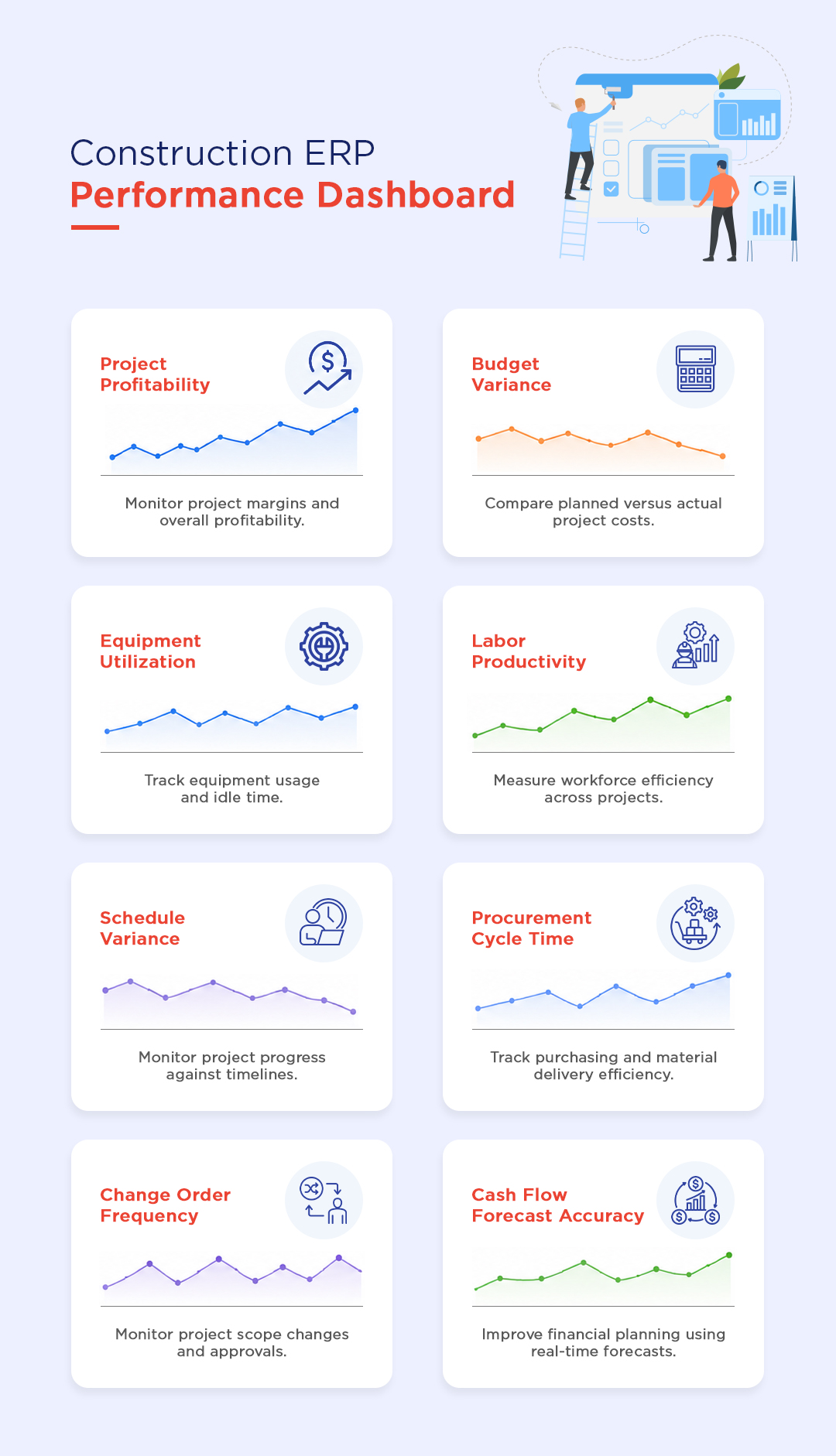
An ERP system gives every team access to the same project information in real time. Project managers can monitor timelines, budgets, resource allocation, and project progress from one dashboard.
Eliminating Manual Processes
Many construction companies still depend on paper documents, spreadsheets, and manual data entry for daily operations. These methods take more time, increase the risk of mistakes, and lead to duplicate work.
A construction ERP automates many routine processes, including purchase orders, payroll, invoicing, inventory updates, and reporting. It reduces paperwork, saves time, and allows employees to focus on higher-value work instead of administrative tasks.
Improving Visibility Across Operations
One of the biggest advantages of an ERP system is complete business visibility. Rather than searching through multiple files or contacting different departments for updates, managers can access real-time reports that show project progress, financial performance, equipment usage, inventory levels, and workforce productivity.
Supporting Business Growth
As construction companies grow, their operations become more complex. Managing additional projects, employees, suppliers, and customers requires better systems and standardized processes.
An ERP system makes expansion easier by organizing business operations and creating consistent workflows across every department. Businesses can take on larger projects, manage multiple job sites, and support more employees without increasing administrative work at the same pace.
For companies with specialized processes or long-term growth plans, investing in ERP development services can help build a solution that grows alongside the business and supports future operational needs.
How ERP Systems Improve Construction Operations
Managing construction projects involves much more than completing work on-site. When those activities are handled through different systems, it becomes difficult to keep projects on track. A construction ERP system connects these operations into one platform to help teams work more efficiently, reduce delays, and make better business decisions throughout every stage of a project.
Project Planning & Scheduling
An ERP system helps project managers create detailed schedules, assign tasks, set milestones, and allocate resources more effectively. As work progresses, managers can monitor project timelines in real time and quickly identify delays before they affect the entire project.
Budget & Cost Control
A construction ERP helps businesses monitor project costs from the beginning. It tracks expenses, labor costs, material purchases, subcontractor payments, and equipment usage while comparing actual spending against the planned budget. Managers can quickly identify cost overruns and make adjustments before they become larger financial problems.
Procurement & Vendor Management
An ERP system simplifies procurement by managing purchase orders, supplier information, contracts, and material deliveries from one place. Managers can track orders in real time and ensure materials arrive when needed. Better supplier management reduces delays and improves inventory planning.
Equipment & Asset Management
An ERP system helps businesses schedule equipment, monitor utilization, track maintenance, and manage the entire lifecycle of their assets. Instead of reacting to unexpected breakdowns, companies can perform preventive maintenance that reduces downtime and extends equipment life.
Workforce Management
Managing workers across different construction sites can become difficult as projects grow. A construction ERP helps companies track employee attendance, working hours, payroll, labor schedules, and productivity from one centralized system. Managers can ensure the right people are assigned to the right projects while monitoring labor costs in real time.
Key Benefits of ERP Systems for Construction Companies
A construction ERP system does more than organize business data. It helps companies complete projects more efficiently, reduce costs, improve teamwork, and make better business decisions. As projects become larger and more complex, these benefits become even more valuable because every department works from the same accurate information.
Better Project Visibility
An ERP system gives managers a complete view of every project from one dashboard. They can monitor budgets, schedules, resource allocation, equipment, and project progress in real time. Having accurate information in one place helps teams identify problems early and make faster decisions before small issues become major delays.
Improved Cost Management
Construction projects involve many expenses, including labor, materials, equipment, and subcontractors. An ERP system tracks these costs throughout the project and compares actual spending with the planned budget. It helps businesses control expenses, reduce waste, and improve overall financial management.
Increased Productivity
Many daily construction tasks can be automated through an ERP system, reducing paperwork and manual data entry. Employees spend less time updating spreadsheets or searching for information and more time completing productive work. Better coordination between office and field teams also helps projects move forward more efficiently.
Faster Decision-Making
Construction managers need accurate information to make important decisions quickly. An ERP system provides real-time reports and dashboards that show project performance, financial data, equipment usage, and workforce productivity. It allows managers to respond faster to changing project conditions and make more informed decisions.
Improved Cash Flow
ERP software helps companies manage invoices, payments, purchase orders, payroll, and project expenses more efficiently. Better financial visibility helps businesses avoid payment delays, improve budgeting, and maintain stronger cash flow throughout the project lifecycle.
Better Collaboration
Construction projects require constant communication between project managers, engineers, subcontractors, suppliers, accountants, and field workers. An ERP system keeps everyone connected by providing access to the same project information. It reduces misunderstandings, improves coordination, and helps teams work together more effectively.
Reduced Administrative Work
Many repetitive tasks, such as payroll processing, invoice creation, inventory updates, reporting, and purchase order management, can be automated. It reduces administrative workload, minimizes human errors, and allows employees to focus on activities that contribute more directly to project success.
Higher Profit Margins
Better planning, lower operating costs, improved resource utilization, fewer project delays, and more accurate financial management help construction companies complete projects more efficiently and increase their profit margins.
Need An ERP System for Your Construction Business?
Our software development team builds custom construction ERP solutions that streamline project management, automate business processes, integrate field and office operations, and scale with your growing business.
Business Functions Construction ERP Can Transform
A construction ERP system connects every department through one centralized platform. Instead of each team using separate software or spreadsheets, everyone works with the same real-time information.
Project Management
Project managers can plan schedules, assign tasks, monitor progress, manage resources, and track project costs from one dashboard. Real-time updates help teams stay on schedule and quickly respond to delays or changes.
Construction Accounting
An ERP system automates invoicing, expense tracking, budgeting, payroll, and financial reporting. Finance teams spend less time on manual calculations while gaining better visibility into project costs and company finances.
Procurement
Purchasing materials becomes faster and more organized with an ERP system. It manages supplier information, purchase orders, approvals, and deliveries in one place to help construction companies avoid delays and control purchasing costs.
Inventory & Materials Management
ERP software tracks material availability, stock levels, and usage across multiple job sites. It helps prevent material shortages, reduces waste, and ensures the right materials are available when projects need them.
Equipment & Fleet Management
Construction companies can monitor equipment usage, maintenance schedules, repair history, and fleet availability from one system. Better equipment management reduces downtime, extends asset life, and improves resource utilization.
HR & Payroll
Managing employees becomes much easier with an ERP system. It keeps employee records, attendance, timesheets, payroll, leave requests, and labor costs organized, reducing administrative work and improving payroll accuracy.
Customer Relationship Management (CRM)
ERP systems can also improve customer management by storing client information, contracts, project updates, and communication in one place. Businesses with more advanced sales and customer management needs often integrate custom CRM development services to manage the complete customer journey more effectively.
Document Management
Construction projects generate thousands of important documents, including contracts, blueprints, permits, inspection reports, invoices, and safety records. An ERP system stores these files securely in one location.
By improving every department, a construction ERP system helps businesses complete projects faster, reduce operating costs, improve collaboration, and make better business decisions using accurate, real-time information.
Essential Features of a Construction ERP System
A construction ERP system should do more than manage basic business tasks. It should help construction companies control projects, monitor costs, improve communication, and manage resources from one platform. Choosing the right features ensures the system supports both current operations and future business growth.
Project Management
Project management is one of the most important features of a construction ERP system. It allows managers to plan projects, assign tasks, monitor progress, track milestones, and manage deadlines from one dashboard. Real-time updates help teams stay informed and quickly respond to delays or changes.
Budgeting & Cost Estimation
Accurate budgeting is essential for profitable construction projects. An ERP system helps estimate project costs, create budgets, monitor expenses, and compare actual spending with planned costs. It helps businesses control their finances and reduce unexpected cost overruns.
Procurement Management
Construction companies work with many suppliers and purchase large amounts of materials throughout a project. An ERP system simplifies procurement by managing supplier information, purchase orders, quotations, approvals, and delivery schedules.
Inventory Management
Construction materials must be available when needed without creating unnecessary stock. An ERP system tracks inventory levels, monitors material usage, and records stock movements across multiple job sites. Better inventory control reduces waste, prevents shortages, and improves project planning.
Equipment Management
Heavy equipment is a major investment for construction companies. An ERP system helps track equipment availability, monitor usage, schedule maintenance, and record repair history. Preventive maintenance reduces unexpected breakdowns and keeps projects running smoothly.
Workforce & Payroll Management
Managing workers across multiple construction sites can be challenging. An ERP system helps businesses manage employee records, attendance, timesheets, shift schedules, payroll, and labor costs from one platform. It improves accuracy while reducing manual administrative work.
Document Management
Construction projects generate many important documents, including contracts, permits, blueprints, inspection reports, and invoices. An ERP system stores these documents securely in one place to make them easy to access, share, and manage. It reduces paperwork and ensures teams always have the latest project information.
Financial Management
Construction companies need complete visibility into their financial performance. An ERP system manages accounts payable, accounts receivable, invoicing, payments, cash flow, budgeting, and financial reporting. Having all financial information in one system improves accuracy and helps business leaders make better financial decisions.
CRM Integration
Managing client relationships is just as important as managing projects. An ERP system that integrates with custom CRM development services allows businesses to manage leads, customer information, project communication, contracts, and after-project support from one connected platform.
Construction ERP Integrations That Improve Efficiency
A construction ERP system becomes even more powerful when it connects with other business applications. Instead of entering the same information into multiple systems, integrations automatically share data between platforms. This reduces manual work, improves accuracy, and helps every department access up-to-date information.
Accounting Software
Integrating accounting software with an ERP system keeps financial information synchronized. Invoices, payments, project expenses, and financial reports update automatically, reducing manual bookkeeping and improving financial accuracy.
CRM Systems
Connecting an ERP system with a CRM allows construction companies to manage leads, clients, contracts, and project communication from one connected platform. Businesses with advanced customer management needs often use custom CRM development services to create CRM solutions that integrate seamlessly with their ERP system.
Payroll Solutions
Payroll integration automatically transfers employee attendance, working hours, overtime, and payroll information between systems. It reduces manual calculations, improves payroll accuracy, and saves HR teams valuable time.
BIM (Building Information Modeling)
Integrating BIM with an ERP system connects project planning with business operations. Project teams can access design updates, construction data, material requirements, and project progress more efficiently, improving coordination throughout the project lifecycle.
Project Management Tools
Project management integrations allow schedules, tasks, milestones, and project updates to sync automatically with the ERP system. It gives managers better visibility into project progress while reducing duplicate data entry.
Estimating Software
Estimating software integration helps transfer project estimates directly into the ERP system. Budgets, material quantities, labor costs, and project forecasts can be used immediately without re-entering information, improving both speed and accuracy.
GPS & Fleet Tracking
Construction companies that manage vehicles and heavy equipment can integrate GPS and fleet tracking systems with their ERP platform. It provides real-time visibility into equipment locations, vehicle usage, maintenance schedules, and fuel consumption, helping businesses improve resource utilization and reduce operating costs.
Document Management Systems
Document management integration keeps contracts, drawings, permits, inspection reports, invoices, and other project files connected with the ERP system. Employees can quickly access the latest documents without searching through multiple folders or applications. By integrating these business systems, construction companies eliminate duplicate work, improve data accuracy, reduce human errors, and create a more connected workflow across every department.
Common Construction Challenges ERP Systems Solve
Construction companies face many challenges as projects become larger and more complex. Managing different teams, suppliers, equipment, and project budgets can quickly become difficult without the right system. A construction ERP helps solve these problems by connecting every department, automating routine tasks, and providing real-time business information.
Budget Overruns
Construction ERP systems track project expenses, labor costs, material purchases, and equipment usage in real time. It helps managers compare actual spending with the project budget, identify cost overruns early, and take corrective action before expenses increase further.
Delayed Projects
Project delays often happen because of poor planning, missing materials, or communication issues. An ERP system keeps project schedules, milestones, and task assignments updated in one place, helping teams identify delays early and keep projects moving forward.
Poor Resource Allocation
Assigning the wrong workers or equipment to projects can reduce productivity and increase costs. An ERP system gives managers complete visibility into available resources, making it easier to assign employees, equipment, and materials where they are needed most.
Material Shortages
Running out of construction materials can stop work and delay projects. An ERP system tracks inventory levels in real time, monitors material usage, and helps procurement teams reorder supplies before stock runs low.
Equipment Downtime
Unexpected equipment failures can delay projects and increase repair costs. ERP software tracks equipment usage, maintenance schedules, and service history, allowing businesses to perform preventive maintenance and keep equipment operating efficiently.
Communication Gaps
Construction projects involve office teams, site managers, subcontractors, suppliers, and clients. An ERP system gives everyone access to the same project information, reducing misunderstandings and improving communication across the entire project.
Disconnected Business Systems
Using separate software for accounting, procurement, payroll, inventory, and project management often creates duplicate work and inconsistent data. An ERP system connects these functions into one platform, improving data accuracy and eliminating unnecessary manual work.
Compliance & Documentation Issues
Construction companies must manage contracts, permits, inspection reports, safety records, and other important documents. An ERP system stores these records securely in one place, making them easier to access, organize, and maintain while helping businesses meet regulatory and project compliance requirements.
Custom ERP vs Off-the-Shelf ERP for Construction Companies
Choosing the right ERP solution is an important decision for any construction company. Some businesses need a system they can start using immediately, while others require software that matches their unique workflows.
Understanding the differences between custom and off-the-shelf ERP systems can help you choose the best option for your business.
| Features | Custom ERP | Off-the-Shelf ERP |
|---|---|---|
| Implementation | Built for your business | Ready to use |
| Customization | Fully customizable | Limited customization |
| Business Fit | Matches your workflows | You adapt to the software |
| Integrations | Can integrate with any required system | Limited to supported integrations |
| Scalability | Grows with your business | Depends on the software provider |
| Ownership | Fully owned by your company | Owned by the vendor |
| Initial Cost | Higher | Lower |
| Long-Term Value | Higher for growing businesses | Good for standard business needs |
Which Option Is Best for Your Construction Business?
There is no single ERP solution that fits every construction company. A ready-made ERP may be the right choice if you:
- Need a faster implementation.
- Have a limited budget.
- Require standard business features.
- Do not need extensive customization.
A custom ERP may be the better choice if you:
- Manage complex construction projects.
- Have unique business workflows.
- Need advanced integrations with existing systems.
- Plan to scale your business over the long term.
- Want complete ownership and control of your software.
AI & Emerging Technologies in Construction ERP
Artificial intelligence and other emerging technologies are changing how construction companies manage projects. Modern ERP systems can now analyze data, predict problems, automate routine tasks, and provide real-time insights.
AI-Powered Project Forecasting
AI can analyze project schedules, budgets, resource usage, and past project data to predict possible delays or cost overruns before they happen. It allows project managers to take corrective action early, improve planning, and keep projects on schedule.
Predictive Equipment Maintenance
Unexpected equipment failures can stop construction work and increase repair costs. AI monitors equipment performance and maintenance history to predict when servicing is needed. It helps companies perform maintenance before breakdowns occur, reducing downtime and extending equipment life.
Intelligent Resource Planning
Construction projects require the right people, equipment, and materials at the right time. AI helps project managers allocate resources more efficiently by analyzing project requirements, workloads, and resource availability. It improves productivity while reducing delays caused by poor planning.
Automated Reporting
Preparing project reports manually takes time and often leads to errors. AI can automatically generate reports using real-time project data, including project progress, budgets, expenses, workforce performance, and equipment usage. This gives managers accurate information without spending hours preparing reports.
AI-Based Risk Analysis
Construction projects involve many risks, including budget overruns, safety issues, project delays, and supply chain disruptions. AI analyzes historical and real-time data to identify potential risks early, helping businesses make informed decisions and reduce costly problems before they affect the project.
Workflow Automation
AI can automate repetitive business processes such as purchase approvals, invoice processing, payroll updates, document routing, and project notifications. It reduces manual work, improves accuracy, and allows employees to focus on more important responsibilities.
IoT Integration for Construction Equipment
Internet of Things (IoT) devices can collect real-time data from construction equipment and send it directly to the ERP system. Managers can monitor equipment location, fuel usage, operating hours, maintenance needs, and overall performance from one dashboard.
As AI and IoT technologies continue to advance, more construction companies are investing in intelligent ERP solutions that automate operations and improve project performance. Businesses planning these advanced capabilities should also understand the cost of building AI-powered business automation software, as AI features can significantly influence the overall development budget and long-term value of an ERP system.
How to Choose the Right ERP System for Your Construction Company
Choosing the right ERP system is an important decision for any construction company. The right solution should support your current operations while also helping your business grow in the future. Instead of focusing only on price, compare the system’s features, flexibility, scalability, and the experience of the software provider. A careful evaluation will help you choose an ERP system that delivers long-term value.
- Clearly identify your business requirements and the challenges you want the ERP system to solve.
- Prioritize the modules you need most, such as project management, accounting, procurement, inventory, payroll, or equipment management.
- Make sure the ERP system can scale as your projects, employees, and business operations continue to grow.
- Choose a provider with proven experience in developing ERP solutions for the construction industry.
- Review integration options to ensure the ERP can connect with your accounting software, CRM, payroll, BIM, and other business applications.
- Compare pricing models by considering implementation costs, licensing, customization, training, maintenance, and future upgrades. It is also helpful to understand the ERP development cost for construction companies before making a decision.
- Check whether the ERP offers mobile access so project managers and field teams can update information directly from construction sites.
- Evaluate the vendor’s customer support, implementation process, training, software updates, and ongoing maintenance services to ensure you have reliable support after deployment.
Best Practices for ERP Implementation
Implementing an ERP system is more than installing new software. It requires proper planning, clean data, employee training, and continuous improvements. A well-planned implementation helps construction companies reduce disruptions, improve user adoption, and get the maximum return on their investment.
Define Clear Objectives
Before starting the implementation, identify what you want the ERP system to achieve. Your goals may include improving project management, reducing costs, automating processes, or increasing productivity. Clear objectives help measure success and keep the project on track.
Map Existing Business Processes
Review your current workflows before implementing the ERP system. Identify inefficient processes, duplicate tasks, and areas that need improvement. Understanding how your business operates makes it easier to configure the ERP system to support your daily operations.
Clean & Migrate Data
Move only accurate and up-to-date information into the new ERP system. Review customer records, supplier details, project data, inventory, and financial information before migration. Clean data improves reporting and helps employees trust the new system from day one.
Train Employees
Employees should understand how to use the ERP system before it becomes part of their daily work. Provide training sessions, user guides, and ongoing support so every department can use the software confidently and efficiently.
Roll Out in Phases
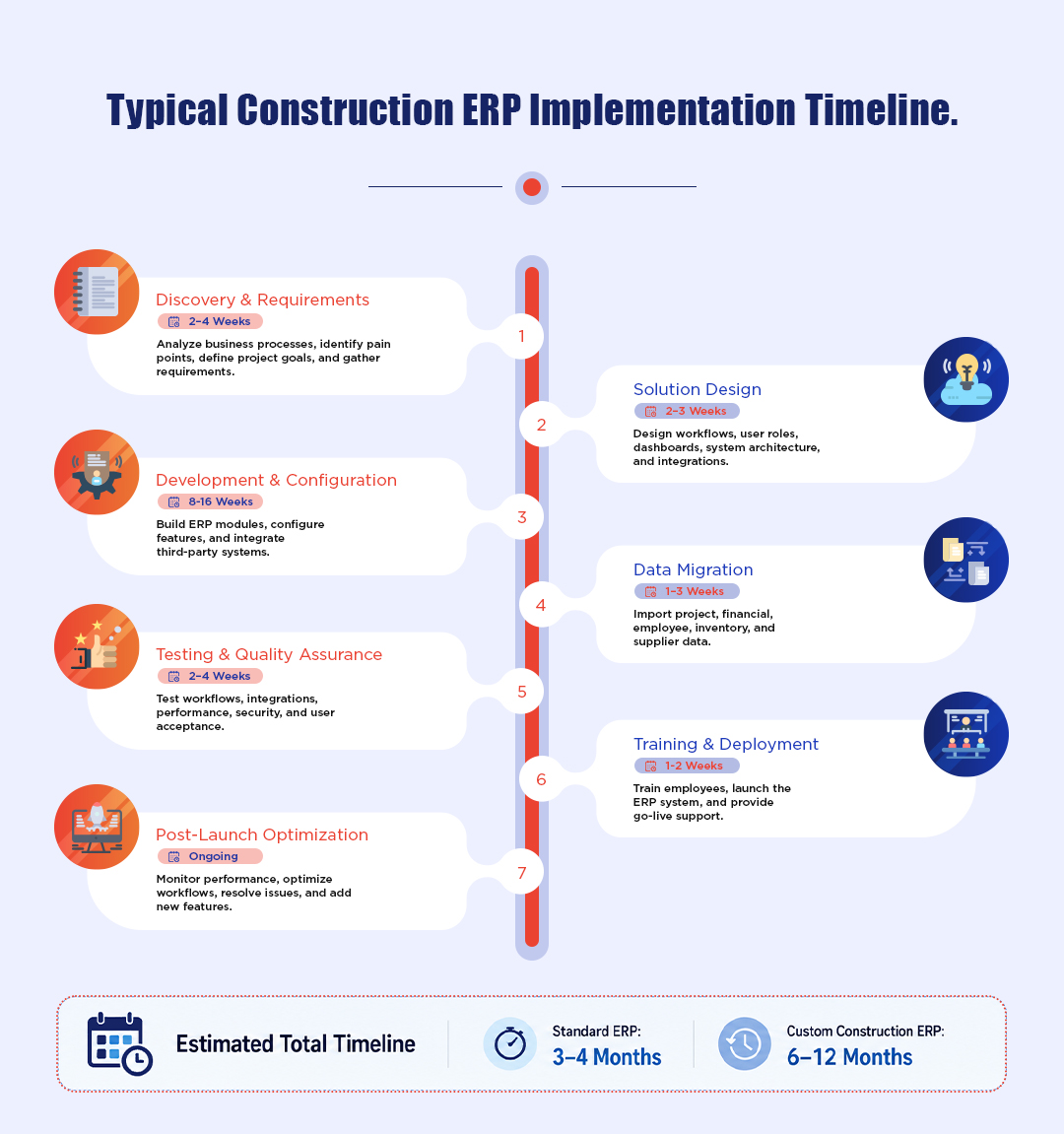
Instead of implementing every module at once, introduce the ERP system in phases. For example, start with accounting and procurement before adding project management, inventory, or payroll. A phased rollout reduces risks and gives employees time to adapt to the new system.
Monitor User Adoption
After implementation, regularly monitor how employees are using the ERP system. Collect feedback, resolve issues quickly, and provide additional training where needed. High user adoption is essential for getting the full value from the software.
Continuously Optimize Workflows
An ERP system should continue improving as your business grows. Regularly review workflows, automate repetitive tasks, and add new features when needed. If you are planning a major ERP implementation, it is also important to know how to evaluate a custom software development vendor before selecting a development partner, as the right vendor plays a key role in the long-term success of your ERP system.
Start Using A CRM Built for Your Construction Business
Our experts build scalable ERP solutions tailored to your construction workflows, helping you reduce costs, improve project visibility, and deliver projects more efficiently.
Frequently Asked Questions
What is a construction ERP system?
A construction ERP system is software that helps construction companies manage projects, accounting, procurement, inventory, equipment, payroll, and other business operations from one centralized platform.
Why do construction companies need ERP software?
Construction companies need ERP software to manage complex projects more efficiently. It helps reduce manual work, control project costs, improve communication, track resources, automate business processes, and provide real-time visibility across every department.
How does ERP improve project management in construction?
ERP improves project management by bringing project schedules, budgets, resources, documents, and progress updates into one system. Project managers can monitor work in real time, identify delays early, allocate resources more efficiently, and keep projects on schedule.
What is the difference between construction ERP and project management software?
Project management software mainly focuses on planning tasks, schedules, and project progress. A construction ERP system manages the entire business by combining project management with accounting, procurement, payroll, inventory, equipment management, CRM, and reporting in one integrated platform.
Should construction companies choose cloud ERP or on-premises ERP?
Cloud ERP is usually the better choice because it offers remote access, automatic updates, lower infrastructure costs, and easier scalability. On-premise ERP may be suitable for companies that require complete control over their servers or have strict internal security requirements.
Can ERP integrate with accounting and BIM software?
Yes. Modern construction ERP systems can integrate with accounting software, BIM platforms, payroll systems, CRM software, estimating tools, document management systems, GPS tracking, and many other business applications. These integrations reduce manual work and improve data accuracy.