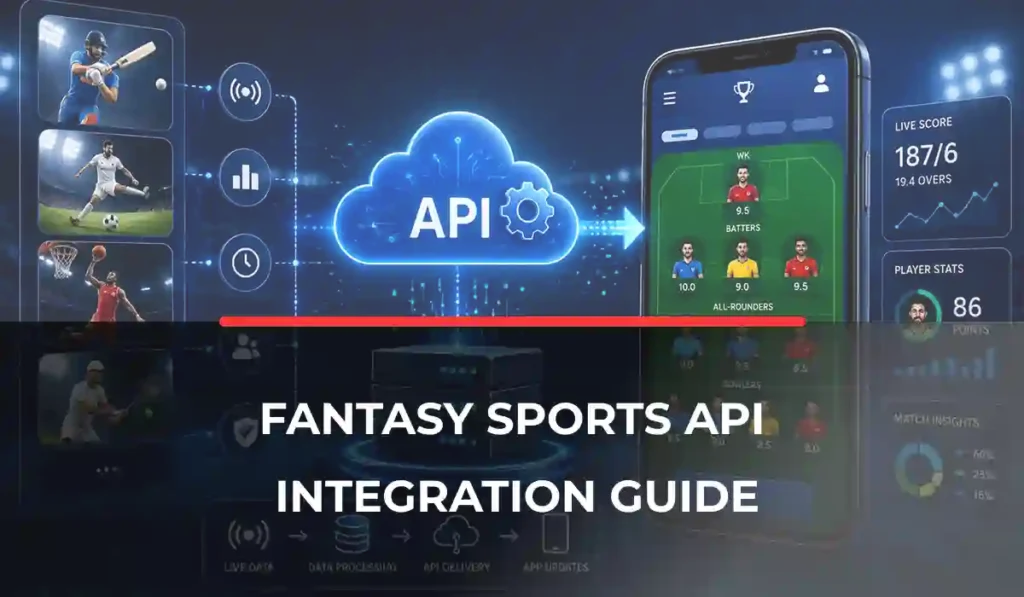
Real-time sports data is the backbone of every successful fantasy sports platform. Users expect live scores, player statistics, match updates, and leaderboard changes to appear almost instantly while a game is in progress. Without reliable data, even the best-designed fantasy sports application cannot deliver an engaging user experience.
This is why fantasy sports API integration is one of the most important parts of fantasy sports app development. APIs connect your platform with sports data providers, allowing your application to retrieve or receive live scores, player performance data, fixtures, team information, and other match data.
In this guide, you will learn how fantasy sports APIs work, the different types of sports data APIs available, how API integration fits into the overall fantasy sports development process, and the key factors to consider before choosing an API provider.
If you are planning to invest in fantasy sports software development, this article will help you understand the business side of API integration before selecting a development partner. For a complete overview of building a fantasy sports platform, you can also explore our complete fantasy sports software guide.
What Is Fantasy Sports API Integration?
Fantasy sports API integration is the process of connecting a fantasy sports platform with trusted sports data providers. These APIs can deliver live scores, player statistics, match schedules, team information, and other real-time updates to the platform.
What Is an API?
An API (Application Programming Interface) acts as a bridge between two systems. In fantasy sports, it connects your platform with a sports data API, allowing match information to flow automatically from the data provider to your application.
Why Do Fantasy Sports Apps Need APIs?
Fantasy sports platforms rely on accurate and real-time data to calculate fantasy points, update leaderboards, and display live match information. Without reliable fantasy sports APIs, users may experience delayed scores, incorrect rankings, or an inconsistent experience. API integration is one important stage of the fantasy sports development process, but it is only one part of building a complete platform.
Why APIs Are Critical for Fantasy Sports Platforms
A fantasy sports platform is only as good as the data it provides. Users expect live scores, accurate player statistics, updated rankings, and real-time contest results throughout a match. Fantasy sports API integration makes this possible by continuously sending fresh sports data to your platform.
Live Scores
Live score APIs provide real-time match updates, ensuring users can follow games as they happen and see their fantasy points change during play.
Player Statistics
Player statistics APIs deliver performance data such as runs, wickets, goals, assists, rebounds, and other sport-specific metrics. This data is used to calculate fantasy points and update team performance.
Fixtures & Match Schedules
Fixture APIs provide upcoming matches, tournament schedules, and match timings. This allows users to create teams before contests begin and stay informed about future games.
Team & Match Information
Sports APIs also supply team lineups, player availability, venue details, and other important match information that helps users make better fantasy team selections.
Contest Automation
Real-time sports data allows the platform to automatically calculate fantasy points, update leaderboards, determine contest winners, and send notifications without manual intervention.
Types of Sports APIs Used in Fantasy Sports
Different APIs provide different types of sports data. Most fantasy sports platforms use multiple sports data APIs to deliver accurate information and keep contests running smoothly. The APIs you need depend on the sports you support and the features available on your platform.
| API Type | Purpose | Used For |
|---|---|---|
| Live Score API | Provides real-time match updates | Live scores, scorecards, match events |
| Player Statistics API | Delivers player performance data | Fantasy point calculation, player rankings |
| Fixtures & Schedules API | Shares upcoming match information | Contest planning, match calendars |
| Sports Odds API | Supplies betting odds and predictions | Prediction platforms, advanced analytics |
| Historical Data API | Provides past match and player data | Performance analysis, user insights |
Live Score APIs
A live score API delivers live or near-real-time match updates as the game progresses. It allows fantasy sports platforms to display current scores, match status, and key events without manual updates. Live score APIs are essential for keeping contests active and users engaged.
Player Statistics APIs
Player statistics APIs provide detailed performance data such as runs, wickets, goals, assists, catches, rebounds, and other sport-specific metrics. Fantasy platforms use this information to calculate fantasy points and update leaderboards accurately.
Fixtures & Schedule APIs
These APIs provide information about upcoming matches, tournament schedules, and match timings. They help users plan their fantasy teams before contests begin and ensure the platform always displays the latest fixture information.
Team & League APIs
Team and league APIs supply information such as team rosters, player lineups, league standings, tournament details, and venue information. This data helps users make informed team selections before joining contests.
Sports Odds APIs
Sports odds APIs provide betting odds, probability data, and match predictions. They are commonly used in sports prediction app development and advanced analytics platforms rather than traditional fantasy sports apps. Some businesses also use this data to enhance user insights and engagement.
Historical Data APIs
Historical data APIs provide records of previous matches, player performances, and season statistics. Businesses often use this data for reporting, performance analysis, predictive models, and future platform enhancements.
How Fantasy Sports API Integration Works
Once a match begins, thousands of data points are generated every minute. Fantasy sports API integration allows the platform to receive and process live sports data with latency determined by the provider, feed type, and integration architecture.
Once integrated, the process can run automatically. Depending on the API, the platform may retrieve updates through scheduled requests or receive them through push/streaming feeds.
Step 1 – Match Begins
A live sporting event starts, generating data such as scores, player performance, substitutions, and other match events.
Step 2 – Data Provider Updates Information
The sports data provider collects and verifies the latest match information before making it available through its API.
Step 3 – API Sends Real-Time Updates
The sports data API provides updated scores, player statistics, fixtures, and other match information through polling or real-time push/streaming feeds, depending on the provider and integration.
Step 4 – Backend Processes the Data
The platform validates the incoming data and updates the relevant contests, player records, and match information.
Step 5 – Fantasy Points Are Calculated
Based on the platform’s scoring rules, fantasy points are automatically calculated using the latest player performance data.
Step 6 – Leaderboards Are Updated
Contest rankings and leaderboards refresh automatically so users can track their position throughout the match.
Step 7 – Users Receive Live Updates
The latest scores, fantasy points, rankings, and notifications are displayed on the mobile app or website, giving users a real-time experience.
Planning Your Fantasy Sports Platform?
Choosing the right sports API is an important part of building a reliable fantasy sports platform. From live scores and player statistics to API architecture and third-party integrations, the right technical approach can make your platform easier to scale and maintain.
Key Factors When Choosing a Sports API Provider
Not all sports API providers offer the same level of service. Choosing the right provider is important because the quality of your sports data directly affects your platform’s performance and user experience.
Before making a decision, evaluate the following factors.
Accuracy
Accurate data is essential for fantasy point calculations and leaderboard updates. Even small errors in player statistics or match events can affect contest results and reduce user trust.
Latency
Latency refers to how quickly the API delivers new match information after an event happens. Lower latency helps users receive live scores and fantasy point updates with minimal delay.
Sports & League Coverage
Check whether the provider supports the sports, leagues, tournaments, and regions your platform plans to cover. Wider coverage gives you more flexibility as your business grows.
Uptime & Reliability
A reliable API should remain available throughout live matches. Frequent downtime or service interruptions can negatively affect contests and the overall user experience.
Documentation
Clear documentation makes API integration easier and helps developers understand available endpoints, data formats, and implementation requirements.
Pricing Model
Compare pricing carefully. Some providers charge based on the number of API requests, while others use monthly subscriptions or custom enterprise plans. Choose a model that fits both your current needs and future growth.
Scalability
As your platform attracts more users, your API should continue delivering data without performance issues. A scalable provider supports increasing traffic during major sporting events and tournaments.
Customer Support
Reliable technical support can save valuable time if issues occur during integration or live events. A responsive support team is especially important for platforms that depend on uninterrupted real-time data.
Checklist: What to Evaluate Before Choosing a Sports API
Sports and league coverage
- Data accuracy
- Real-time update speed
- Uptime and reliability
- Easy-to-follow documentation
- Pricing and licensing model
- Rate limits and usage policies
- Scalability for future growth
- Security standards
- Technical support and response time
Common Challenges in Fantasy Sports API Integration
Even the best sports data APIs can face challenges. If these issues are not managed properly, they can affect user experience, contest accuracy, and platform performance. Understanding these challenges helps businesses choose the right integration strategy from the beginning.
Delayed Live Scores
Real-time updates are essential for fantasy sports. If score updates are delayed, fantasy points and leaderboards may not reflect the actual match, leading to user frustration.
API Rate Limits
Many API providers limit the number of requests that can be made within a certain period. During popular matches with high user activity, these limits can affect how quickly data is updated if they are not planned for properly.
Data Inconsistency
Different data providers may report match events differently or update information at different times. This can result in inconsistent player statistics or scoring if the platform relies on multiple data sources.
API Downtime
If a sports API provider experiences downtime during a live match, your platform may stop receiving updates. This can interrupt contests and reduce user confidence in your application.
Synchronizing Multiple APIs
Some fantasy sports platforms use more than one API to improve coverage or support multiple sports. Keeping data synchronized across different providers can be challenging and requires careful planning.
Error Handling
Unexpected API errors, missing data, or connection failures should be handled properly to avoid affecting the user experience. A reliable platform should continue operating smoothly even when temporary issues occur.
Best Practices for Fantasy Sports API Integration
A successful fantasy sports API integration is not just about connecting an API. It also requires proper planning to ensure the platform remains fast, reliable, and scalable as the user base grows. Following these best practices helps improve performance and reduce potential issues.
Use Caching
Caching frequently accessed data helps reduce unnecessary API requests and improves platform performance. It also minimizes the impact of temporary API delays.
Plan for API Failures
Even highly reliable APIs can experience temporary outages, delays, or service interruptions. Your platform should be able to detect failures and handle them without interrupting the user experience.
Consider Backup Data Providers
Some platforms use multiple sports data providers to improve coverage or provide redundancy. Having a backup provider helps maintain service if the primary API experiences downtime or delays.
Monitor API Performance
Regularly monitoring API response times, uptime, and data accuracy helps identify issues before they affect users. Continuous monitoring also improves long-term platform reliability.
Keep APIs Updated
API providers regularly release new versions and improvements. Keeping integrations updated ensures compatibility, better performance, and continued access to the latest features.
Prioritize Security
APIs should be integrated securely to protect user data and prevent unauthorized access. Following security best practices helps maintain platform reliability and user trust.
Test Before Every Major Release
Whenever new features or API updates are introduced, testing should be completed before deployment. This helps identify issues early and ensures the platform continues to deliver accurate real-time sports data.
Following these best practices helps businesses build a stable and scalable platform while delivering a consistent experience for fantasy sports users.
API Integration Costs
The cost of fantasy sports API integration depends on several factors, including the type of sports data you need, the number of supported sports, and how frequently your platform requests updates. Choosing the right API is not only a technical decision but also an important business investment.
API Licensing
Some sports API providers offer monthly or annual subscription plans, while others charge based on usage or provide custom enterprise pricing. The licensing model you choose can significantly affect your long-term costs.
Usage Volume
Some providers price their services based on API usage or request volume, while others use subscription, package, or custom enterprise pricing. As your user base grows and more live matches are supported, API usage and related costs may also increase.
Sports & League Coverage
Supporting multiple sports, leagues, or international tournaments usually requires access to more data, which can increase API licensing fees.
Premium Data
Advanced data packages, such as detailed statistics, play-by-play data, historical data, or odds, may be available only on higher-tier or separately priced plans.
API expenses should always be considered as part of your overall fantasy sports app development pricing. Understanding these cost factors early helps businesses plan a realistic budget and choose the right data provider for their needs.
How DynamoLogic Solutions Integrates Sports APIs
Reliable API integration is essential for building a successful fantasy sports platform. At DynamoLogic, we integrate trusted fantasy sports APIs to deliver accurate live scores, player statistics, fixtures, and real-time match updates while ensuring the platform remains fast, secure, and scalable.
Reliable Sports Data Integration
We work with trusted sports API providers to integrate high-quality sports data that supports accurate fantasy point calculations, live leaderboards, and real-time contest updates.
Performance Optimization
Our team optimizes API communication to reduce delays and improve response times. This helps users receive live match updates quickly, even during high-traffic sporting events.
Scalable Architecture
Every platform is designed to support future growth. Whether you are launching with a single sport or expanding to multiple leagues and tournaments, we build API integrations that can scale with your business.
Real-Time Synchronization
We ensure that live scores, player statistics, fantasy points, and contest rankings stay synchronized across your web and mobile applications, providing users with a consistent experience.
End-to-End Support
From selecting the right sports data API to deployment and ongoing maintenance, our team supports every stage of your fantasy sports app development journey. We focus on building reliable, high-performance platforms that deliver accurate real-time sports data and an engaging user experience.
Ready to Build a Fantasy Sports Platform?
Whether you need live score integration, player statistics, or complete fantasy sports software development, DynamoLogic can help you build a secure, scalable, and high-performing fantasy sports platform tailored to your business goals.
Conclusion
Reliable fantasy sports API integration is the foundation of every successful fantasy sports platform. From live scores and player statistics to automated fantasy point calculations and real-time leaderboards, APIs make it possible to deliver the fast and accurate experience that users expect.
Choosing the right sports API provider is just as important as choosing the right development partner. Factors such as data accuracy, update speed, coverage, scalability, pricing, and long-term reliability all play a major role in your platform’s success.
FAQs
What is a fantasy sports API?
A fantasy sports API is a service that provides real-time sports data such as live scores, player statistics, match schedules, team information, and other updates. Fantasy sports platforms use this data to calculate points, update leaderboards, and display live match information.
How do fantasy sports apps get live scores?
Fantasy sports apps receive live scores through sports data APIs. These APIs continuously send match updates from trusted data providers to the platform, allowing users to view real-time scores and contest updates.
Which APIs are required for fantasy sports apps?
Most platforms use a combination of APIs, including live score APIs, player statistics APIs, fixtures and schedules APIs, team information APIs, and historical data APIs. Some businesses also integrate sports odds APIs for prediction-based platforms.
Can one API support multiple sports?
Yes. Many sports API providers support multiple sports and leagues through a single platform. However, the available sports and level of data coverage vary from one provider to another.
How accurate are sports data APIs?
Reputable API providers typically use established data-collection and verification processes, but data coverage, accuracy, and update frequency vary by provider and sport. The level of accuracy depends on the provider, the sport, and the type of data being supplied.