Many businesses start with ready-made software because it is quick to set up and usually costs less. In the beginning, these tools may work well. However, as your business grows, your needs also change. You may have more customers, more employees, more departments, and more daily tasks to manage. At this stage, off-the-shelf software may become difficult to use.
If your current software is creating more problems than solving them, it may be time to consider custom software development services. A solution built specifically for your business can automate daily work, connect your existing systems, improve efficiency, and support future growth.
In this guide, you will learn the most common signs that your business has outgrown off-the-shelf software, the problems custom software can solve, and how to decide whether investing in a custom solution is the right choice for your business.
What Is Custom Software Development?
Custom software development is the process of building software specifically for the needs of one business. Rather than using a ready-made solution with fixed features, custom software is designed around your workflows, goals, and daily operations, which gives businesses more flexibility, better efficiency, and software that can grow as the business grows.
What Is Custom Software?
Custom software is built to solve the specific challenges of a business. Every feature, workflow, and integration is developed based on how the company operates.
Unlike ready-made software that is used by thousands of businesses, custom software is created only for your organization. This means you only get the features you need, which makes the software easier to use and more efficient.
Off-the-Shelf Software vs Custom Software
Off-the-shelf software is designed for a wide range of businesses. It is usually faster to set up and has a lower upfront cost, but it may include features you never use while missing features your business actually needs.
Custom software is developed specifically for your company. It can be integrated with your existing systems, expanded as your business grows, and customized whenever your requirements change.
| Features | Off-the-Shelf Software | Custom Software |
|---|---|---|
| Setup Time | Fast | Longer development time |
| Customization | Limited | Fully customizable |
| Features | General business features | Built for your exact needs |
| Integrations | Limited | Can integrate with your existing systems |
| Scalability | Depends on the vendor | Grows with your business |
| Ownership | Owned by the software provider | Owned by your business |
| Long-Term Flexibility | Limited | High |
If you are unsure which option is better for your business, comparing SaaS vs custom software can help you understand the differences and choose the right solution.
KEY TAKEAWAY
Off-the-shelf software may be the right choice when you need a quick and affordable solution. However, businesses with complex workflows often benefit from software designed around their specific requirements.
Who Benefits Most from Custom Software?
Many industries benefit from custom software because every business has different processes and goals.
→ Small and medium-sized businesses (SMEs) that want to automate operations and prepare for growth.
→ Growing enterprises that need software capable of handling more users, customers, and business processes.
→ Multi-location businesses that want to manage all branches through one centralized system.
→ Healthcare organizations that require secure patient management systems and compliance features.
→ Financial organizations that need secure workflows, reporting, and regulatory compliance.
→ Logistics companies that manage deliveries, fleets, inventory, and supply chains.
→ Manufacturing companies that want to automate production, inventory, and resource planning.
→ Retail businesses that need better inventory control, customer management, and sales reporting.
→ Construction companies that manage projects, equipment, procurement, and budgets across multiple job sites.
→ Professional service firms that want to improve project management, customer communication, and internal workflows.
Why Businesses Eventually Outgrow Off-the-Shelf Software
Off-the-shelf software is a good starting point because it is affordable and quick to implement. However, as a business grows, its operations become more complex. More customers, more employees, and more departments create new requirements that generic software was never designed to handle. After some time, businesses find themselves working around the system instead of having technology support their operations.
1. Business Growth Creates New Requirements
As your business expands, the amount of data, transactions, and daily work also increases. A system that worked well for a small team may struggle when the company has multiple departments, locations, or product lines. Businesses need additional workflows, approvals, reporting, and automation that were not necessary in the early stages.
2. Generic Software Isn’t Built Around Your Processes
Ready-made software is designed for many different businesses, not specifically for yours. As a result, employees may be forced to change their workflows to match the software. The system may include features you never use while lacking important functionality that your team needs every day.
Custom software solves this problem by aligning the technology with your actual business processes instead of forcing your business to adapt to generic tools.
3. Integration Becomes Difficult
Many growing businesses use separate systems for sales, accounting, inventory, HR, customer support, and reporting. When these systems do not communicate properly, employees have to export and import data manually. This creates duplicate records, inconsistent information, and a higher risk of errors.
A custom solution can integrate these systems and create a single source of accurate business data.
4. Scalability Challenges
Off-the-shelf software may have limitations on users, storage, performance, or available features. As your business grows, licensing costs can increase, performance may slow down, and important capabilities may require expensive upgrades. Some businesses eventually discover that the software cannot support their long-term growth plans.
At this stage, many companies begin exploring custom software development services because they need a system that can scale with their business instead of becoming another operational bottleneck.
The Real Problem Is Not Your Software: It Is the Growing Gap Between Your Needs and Your Tools
As businesses grow, their processes become more complex. The challenge is not having software; it is having software that can adapt to changing workflows, increasing users, and new business requirements.
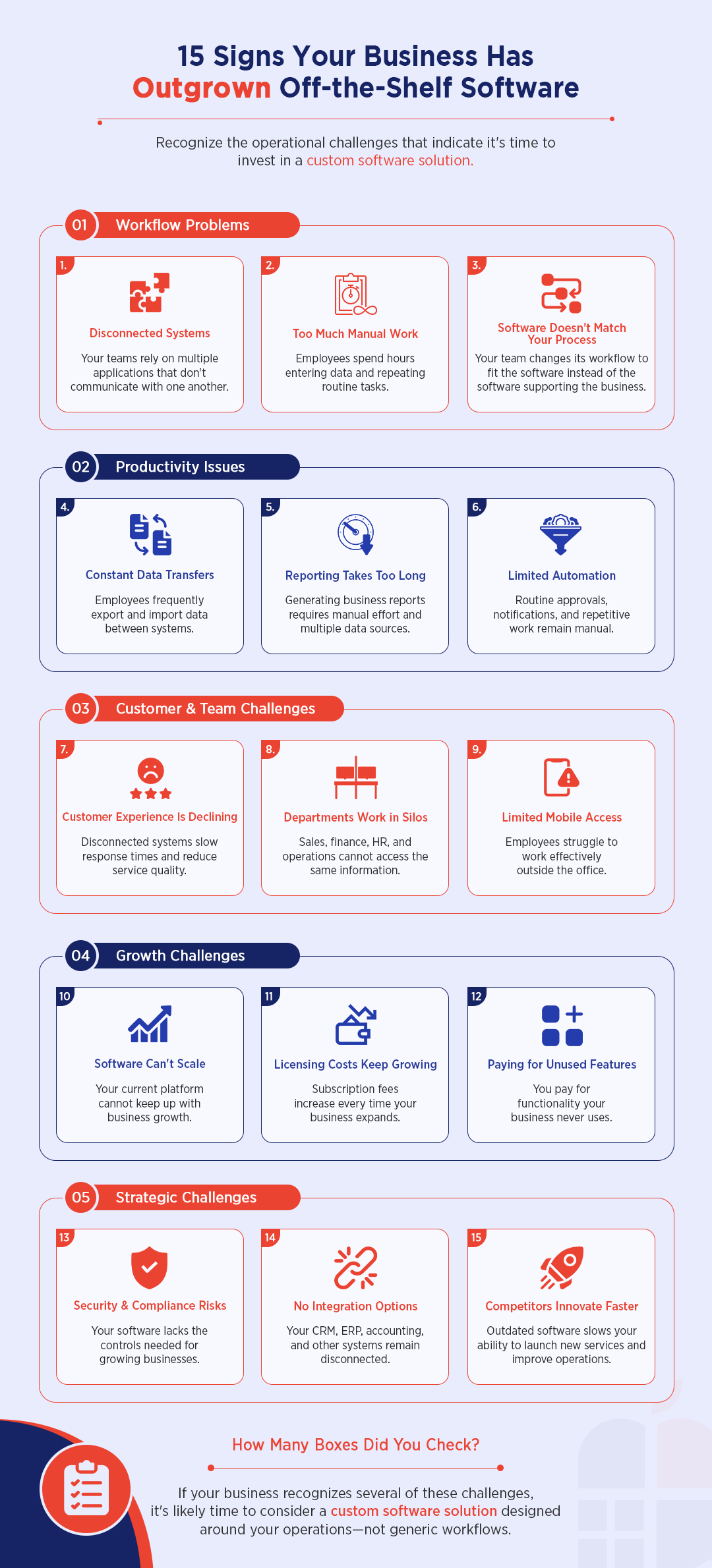
15 Signs Your Business Needs Custom Software Development
Every business reaches a stage where ready-made software can no longer support its daily operations. As your company grows, manual work increases, systems become disconnected, and employees spend more time solving software problems than serving customers.
If you recognize several of these signs, it may be the right time to invest in a custom solution.
1. You’re Relying on Multiple Disconnected Systems
Using separate software for different departments makes work slower and creates unnecessary confusion. A custom solution connects your systems so information flows automatically.
- Employees switch between several applications.
- Data is stored in different places.
- Information is entered multiple times.
- Teams struggle to find accurate records.
- Reporting becomes more difficult.
2. Employees Spend Too Much Time on Manual Tasks
Manual work takes valuable time away from more important business activities. Custom software automates repetitive tasks so employees can focus on higher-value work.
- Data is entered manually every day.
- Spreadsheets are updated repeatedly.
- Approvals take too long.
- Routine tasks slow productivity.
- Human errors happen more often.
3. Your Business Processes Don’t Match Your Software
Your software should fit your business, not the other way around. When employees constantly create workarounds, it is a clear sign your current software is limiting growth.
- Teams change their workflow to match the software.
- Important features are missing.
- Employees rely on manual workarounds.
- Daily tasks become more complicated.
- Productivity continues to decrease.
4. You Frequently Export Data Between Applications
If employees regularly move data between systems, your software is not working together properly. Custom software connects applications and removes duplicate work.
- Data is copied between systems.
- Duplicate records appear often.
- Reports require manual exports.
- Information becomes inconsistent.
- Employees waste time moving data.
5. Customer Experience Is Suffering
Customers expect fast and reliable service. Slow systems and disconnected information can affect their overall experience.
- Customer requests take longer to handle.
- Order processing is delayed.
- Staff cannot quickly access customer information.
- Service quality becomes inconsistent.
- Customer satisfaction begins to decline.
6. Reporting Takes Too Long
Business leaders need quick access to accurate information. Custom software provides real-time reports instead of manual reporting.
- Reports require manual preparation.
- Information comes from multiple systems.
- Managers wait for important data.
- Reports contain errors.
- Decisions are delayed.
7. Your Software Can’t Scale with Growth
As your business grows, your software should grow with it. If it cannot handle more users, customers, or transactions, it may be time for a better solution.
- Performance becomes slower.
- User limits affect operations.
- New features cannot be added easily.
- Business growth is restricted.
- Software upgrades become difficult.
8. You’re Paying for Features You Never Use
Many businesses pay for large software packages while using only a small number of features. Custom software includes only the tools your business actually needs.
- Unused features increase costs.
- Monthly licensing fees continue growing.
- Employees use only basic functions.
- Customization is limited.
- The software delivers poor value.
9. Security and Compliance Are Becoming Concerns
As businesses grow, protecting data becomes more important. Custom software allows stronger security and better control over sensitive information.
- User permissions are limited.
- Sensitive business data needs better protection.
- Compliance reporting is difficult.
- Audit records are incomplete.
- Security depends on third-party updates.
10. Mobile Access Is Limited
Today’s employees often need access to business systems from different locations. Custom software can include mobile access designed around your business needs.
- Employees cannot work remotely.
- Field teams lack real-time updates.
- Mobile features are missing.
- Approvals are delayed.
- Information is difficult to access outside the office.
11. Departments Work in Silos
When departments use different software, collaboration becomes difficult. Custom software connects every team through one centralized platform.
- Sales and finance use different systems.
- Teams cannot share information easily.
- Duplicate work increases.
- Communication gaps appear.
- Business visibility becomes limited.
12. You Need More Automation
As workloads increase, automation becomes essential for improving efficiency. Many businesses start investing in custom solutions after exploring how businesses in the UAE automate operations with custom software to reduce manual work.
- Routine tasks remain manual.
- Employees repeat the same work.
- Approval processes are slow.
- Notifications require manual follow-up.
- Productivity remains low.
13. Custom Integrations Are Impossible
Businesses need their software to connect with CRM, ERP, accounting, or third-party applications. If your current software cannot integrate properly, it may be holding your business back.
- Existing systems cannot communicate.
- API support is limited.
- Data transfers are manual.
- Business information stays disconnected.
- New software cannot be integrated.
14. Software Licensing Costs Keep Increasing
Subscription costs often increase as your business grows. In many cases, businesses discover that investing in custom software development services becomes more cost-effective over the long term.
- Every new user requires another license.
- Premium features cost extra.
- Upgrade fees continue increasing.
- Long-term software costs become difficult to manage.
- The business pays for features it does not need.
15. Your Competitors Are Innovating Faster
Businesses using modern technology can launch new services, automate operations, and respond to customer needs more quickly. If outdated software is slowing your business, competitors may gain an advantage.
- Competitors release new features faster.
- Customers expect better digital experiences.
- Your business struggles to keep up.
- Innovation is limited by existing software.
- Growth opportunities are missed.
Operational Challenges Custom Software Solves
Many businesses continue using software that creates extra work instead of making work easier. As the business grows, these problems become more noticeable and start affecting productivity, customer service, and profitability.
Custom software is designed around your business processes to help eliminate these challenges and improve overall efficiency.
1. Inefficient Workflows
Custom software is built around the way your business operates to allow employees to complete tasks faster without unnecessary steps.
- Removes unnecessary manual processes.
- Simplifies daily workflows.
- Reduces repetitive tasks.
- Improves team productivity.
- Speeds up business operations.
2. Duplicate Data Entry
Entering the same information into multiple systems wastes time and increases the risk of errors. Custom software keeps all business data connected in one place.
- Eliminates repeated data entry.
- Keeps records consistent.
- Reduces human errors.
- Saves employee time.
- Improves data accuracy.
3. Communication Gaps
When departments use different systems, important information is often delayed or lost. Custom software improves communication by connecting teams through one centralized platform.
- Teams share information instantly.
- Reduces misunderstandings.
- Improves collaboration.
- Keeps everyone working with the same data.
- Speeds up decision-making.
4. Slow Decision-Making
Business leaders need accurate information to make good decisions. Custom software provides real-time dashboards and reports so managers always have the latest business data.
- Real-time business insights.
- Faster reporting.
- Better visibility across departments.
- More informed decisions.
- Quicker response to business changes.
5. Poor Customer Experience
Customers expect fast service and accurate information. Custom software helps businesses deliver a smoother customer experience by connecting customer data and automating routine processes. Businesses that need advanced customer management often combine custom software with custom CRM development services.
- Faster customer support.
- Quicker response times.
- Better order tracking.
- Personalized customer experiences.
- Improved customer satisfaction.
6. Limited Business Visibility
When information is spread across different systems, it is difficult to understand how the business is performing. Custom software brings all important data into one dashboard.
- One source of business data.
- Better performance tracking.
- Easier KPI monitoring.
- Improved operational visibility.
- More accurate reporting.
7. Inventory or Resource Tracking Issues
Managing inventory, equipment, or employees becomes difficult when data is not updated in real time. Custom software helps businesses track resources more accurately.
- Real-time inventory tracking.
- Better resource planning.
- Reduced stock shortages.
- Improved asset management.
- Less waste and better utilization.
8. Compliance Management
Many industries must follow strict regulations and maintain accurate records. Custom software can automate compliance tasks and make audits much easier.
- Stores records securely.
- Tracks user activity.
- Automates compliance reporting.
- Improves document management.
- Reduces compliance risks.
Outgrown Your Current Software?
Build a custom software solution designed around your business needs. We help you automate workflows, connect your systems, improve operational efficiency, and create a scalable platform that grows with your business.
Business Processes That Benefit from Custom Software
Custom software can improve almost every part of a business by replacing manual work with automated processes and connecting different departments through one system.
Customer Relationship Management
A custom CRM helps businesses manage customer information, sales activities, and communication in one place. It is designed around your sales process and customer journey. Businesses with unique requirements benefit from custom CRM development services because the system can be customized as the business grows.
Sales Automation
Custom software automates repetitive sales tasks such as lead tracking, follow-ups, quotations, approvals, and reporting, which allows sales teams to spend less time on administrative work and more time building customer relationships and closing deals.
Inventory Management
A custom inventory management system provides real-time visibility into stock levels, warehouse movements, and product availability. It helps businesses reduce stock shortages, avoid overstocking, and improve inventory accuracy across multiple locations.
Project Management
Custom project management software helps businesses organize projects, assign tasks, monitor deadlines, and track progress from one platform. It improves collaboration between teams and helps managers complete projects more efficiently.
HR & Employee Management
Custom HR software simplifies employee management by centralizing records, attendance, leave requests, payroll, and performance tracking. Automating these processes reduces administrative work and helps HR teams manage employees more effectively.
Finance & Accounting
Custom finance software automates invoicing, expense tracking, budgeting, financial reporting, and payment management. It reduces manual calculations, improves accuracy, and gives business owners better visibility into their financial performance.
Procurement
Custom procurement software streamlines the purchasing process by managing suppliers, purchase requests, approvals, and orders in one system. It helps businesses control spending, reduce delays, and improve supplier management.
Customer Portals
Customer portals give clients secure access to important information such as orders, invoices, documents, support requests, and account details. Providing customers with self-service options improves convenience while reducing the workload on support teams.
Workflow Automation
Custom software automates repetitive business processes such as approvals, notifications, document handling, and task assignments. Businesses looking to expand automation can also learn how AI is transforming business automation to see how AI is making business operations even more efficient.
Business Intelligence & Reporting
Custom reporting tools collect data from different departments and present it through real-time dashboards and reports. Business leaders gain better visibility into operations, monitor key performance indicators, and make faster, data-driven decisions.
Benefits of Investing in Custom Software Development
Investing in custom software helps businesses solve current operational problems while preparing for future growth. Rather than depending on software with limited flexibility, businesses get a solution that matches their workflows, improves efficiency, and adapts as their needs change.
Over time, this leads to better productivity, stronger customer relationships, and improved business performance.
- Improved operational efficiency by streamlining business processes and reducing unnecessary steps.
- Higher employee productivity through automation and faster access to the information employees need.
- Better customer experience with quicker service, personalized interactions, and smoother customer journeys.
- Reduced manual work by automating repetitive tasks such as data entry, approvals, and reporting.
- Greater scalability so the software can support new users, locations, departments, and business growth.
- Enhanced security with custom access controls, stronger data protection, and security features designed for your business.
- Better decision-making through real-time dashboards, accurate reporting, and centralized business data.
- Competitive advantage by supporting unique business processes that standard software cannot provide.
- Lower long-term software costs by reducing recurring licensing fees, manual work, and operational inefficiencies.
- Complete ownership and flexibility with full control over future updates, new features, and system integrations as your business evolves.
LONG-TERM VALUE OF CUSTOM SOFTWARE
The biggest advantage of custom software is not only solving today’s problems. It creates a technology foundation that can support future growth, new services, and changing business needs.
When Should You Invest in Custom Software?
Not every business needs custom software from the beginning. However, there comes a point where ready-made software starts limiting growth instead of supporting it.
If your business is facing ongoing operational challenges, investing in a custom solution can provide long-term value and help you operate more efficiently.
Your Business Is Growing Rapidly
As your customer base, employees, and daily operations increase, your software should be able to keep up. If your current system is slowing down or cannot support your growth, custom software can provide the flexibility and scalability your business needs.
Your Team Uses Multiple Software Tools
Using different applications for sales, accounting, inventory, HR, and customer support often leads to duplicate work and inconsistent data. Custom software connects these systems into one platform, making daily operations simpler and more efficient.
Manual Work Is Slowing Down Operations
If employees spend hours entering data, updating spreadsheets, or repeating the same tasks every day, automation can save significant time. Custom software reduces manual work, improves accuracy, and allows employees to focus on more important responsibilities.
You Need Better Business Insights
Growing businesses need quick access to accurate information. If reports take too long to prepare or important data is spread across different systems, custom software can provide real-time dashboards and reporting that support faster business decisions.
Your Customers Expect Better Digital Experiences
Modern customers expect fast service, online access, and smooth communication. Custom software helps businesses improve customer experiences by providing personalized services, self-service portals, faster support, and better communication.
Your Business Has Unique Processes
Every business operates differently. If your workflows cannot be supported by ready-made software, a custom solution allows you to build features that match the way your business actually works instead of forcing employees to follow generic processes.
You’re Planning Long-Term Growth
If your goal is to expand into new markets, open new locations, launch new services, or automate more business processes, investing in custom software now can provide a strong technology foundation for future growth.
Before starting development, it is also important to understand how to plan a successful software development project so your goals, budget, and requirements are clearly defined from the beginning.
Custom Software Features Businesses Commonly Need
The features included in custom software depend on the needs of each business. Unlike ready-made software, custom solutions only include the functionality that supports your operations. It makes the software easier to use, improves efficiency, and helps businesses grow without unnecessary limitations.
- Automate repetitive tasks such as approvals, notifications, and data entry to reduce manual work and improve productivity.
- Restrict access based on employee roles to improve security and protect sensitive business information.
- View real-time dashboards with live business data, KPIs, and reports for faster and more informed decision-making.
- Access the software through mobile applications so employees and customers can stay connected from anywhere.
- Deploy the software on the cloud to improve scalability, accessibility, and system reliability.
- Provide customer self-service portals where users can view orders, submit requests, download documents, and manage their accounts without contacting support.
- Add AI and machine learning features to automate processes, generate predictions, and improve business efficiency. Businesses planning AI adoption can also explore the cost of building AI-powered business automation softwarebefore investing.
- Generate detailed reports and business analytics to monitor performance, identify trends, and support strategic planning.
- Connect CRM, ERP, accounting software, payment gateways, and other business applications through API integrations to eliminate duplicate work and improve data accuracy.
- Manage business documents securely with centralized storage, version control, and easy document sharing across departments.
Systems Custom Software Can Integrate With
One of the biggest advantages of custom software is its ability to connect with the systems your business already uses. Instead of keeping information in separate applications, integrations allow data to move automatically between platforms.
CRM Platforms
Custom software can integrate with CRM systems to keep customer information, sales activities, and support records synchronized. It helps sales and customer service teams work with the same customer data.
ERP Systems
Connecting with ERP development services allows businesses to manage finance, inventory, procurement, and operations through one connected system. It improves efficiency and provides better visibility across the business.
Accounting Software
Integration with accounting software automatically updates invoices, payments, expenses, and financial records, which reduces manual bookkeeping and improves financial accuracy.
HR Systems
Custom software can connect with HR platforms to synchronize employee records, attendance, payroll, leave requests, and performance information, reducing administrative work.
Payment Gateways
Businesses can integrate secure payment gateways to process online payments, subscriptions, invoices, and refunds quickly while providing a better customer experience.
Inventory Systems
Connecting inventory systems with sales and purchasing ensures stock levels are updated automatically. It helps prevent stock shortages, reduces overstocking, and improves inventory management.
E-commerce Platforms
Custom software can integrate with e-commerce platforms to synchronize products, orders, customers, inventory, and shipping information, which makes online business operations more efficient.
Marketing Automation Tools
Integrating marketing platforms allows businesses to manage email campaigns, customer segmentation, lead nurturing, and marketing performance from connected business data.
Business Intelligence Platforms
Custom software can integrate with business intelligence tools to combine data from different departments into one dashboard. It removes data silos, improves reporting, and helps business leaders make faster and more informed decisions.
Custom Software vs Off-the-Shelf Software: Which Is Right for Your Business?
Choosing between custom software and off-the-shelf software depends on your business goals, budget, and long-term plans. Ready-made software is a good starting point for small businesses, while custom software becomes more valuable as operations become more complex. Understanding the strengths of each option can help you make the right investment.
| Features | Off-the-Shelf Software | Custom Software |
|---|---|---|
| Upfront Cost | Lower | Higher |
| Deployment | Fast | Longer development time |
| Customization | Limited | Fully customized |
| Scalability | Depends on the vendor | Built to grow with your business |
| Integrations | Limited | Designed for your existing systems |
| Ownership | Vendor owns the software | Business owns the software |
| Pricing | Monthly or annual subscription | One-time development with ongoing maintenance |
| Long-Term Value | May become expensive over time | Higher long-term ROI |
Decision Checklist
Before deciding which option is right for your business, consider the following questions:
↪ Is your company growing quickly?
↪ Are your business processes unique or complex?
↪ Can your current software support your future growth?
↪ Do you need to integrate multiple business systems?
↪ Are there industry-specific security or compliance requirements?
↪ Are subscription costs becoming difficult to manage?
↪ Does your existing software stack create duplicate work or data silos?
If you answer yes to several of these questions, custom software is likely to provide greater long-term value.
AI & Emerging Technologies in Custom Software
Artificial intelligence and emerging technologies are helping businesses automate more work, improve decision-making, and deliver better customer experiences. By adding these technologies to custom software, businesses can reduce manual effort, increase efficiency, and gain a competitive advantage.
AI-Powered Business Automation
AI can automate repetitive tasks such as data entry, approvals, customer support, and document processing. This saves time, reduces errors, and allows employees to focus on higher-value work. Businesses interested in automation can learn how AI is transforming business automation to understand its growing impact.
Predictive Analytics
Predictive analytics uses historical business data to identify trends and forecast future outcomes. It helps businesses plan inventory, predict customer demand, reduce risks, and make better business decisions.
Intelligent Reporting
AI-powered reporting collects and analyzes data automatically, providing real-time dashboards and business insights. Instead of spending hours creating reports manually, managers can quickly access accurate information whenever they need it.
Chatbots & Virtual Assistants
AI chatbots and virtual assistants provide instant responses to customer questions, handle routine support requests, and assist employees with everyday tasks. It improves customer service while reducing the workload on support teams.
Process Automation (RPA)
Robotic Process Automation (RPA) automates repetitive business processes such as invoice processing, data transfers, approvals, and report generation. It improves speed, accuracy, and overall operational efficiency.
IoT Integration
Custom software can integrate with Internet of Things (IoT) devices to collect real-time data from equipment, vehicles, sensors, and other connected devices. It helps businesses monitor operations, improve maintenance, and make faster decisions.
Machine Learning Personalization
Machine learning helps businesses deliver personalized experiences by analyzing customer behavior and preferences. It can recommend products, customize content, predict customer needs, and improve marketing performance, helping businesses build stronger customer relationships and stay ahead of competitors.
How to Know If Custom Software Is Worth the Investment
Custom software is an investment that should deliver long-term value, not just solve today’s problems. Before making a decision, evaluate how your current software affects productivity, costs, customer experience, and future growth.
If your business is losing time and money because of inefficient systems, custom software may provide a strong return on investment.
- Calculate how much time and money are spent on manual work, duplicate data entry, and inefficient processes.
- Measure how much productivity is lost because employees use multiple systems or outdated software.
- Estimate potential revenue that could be gained by improving efficiency, serving customers faster, or launching new services.
- Compare your current software licensing and subscription costs with the long-term value of owning custom software.
- Consider your future growth plans and whether your current software can support more users, locations, and business processes.
- Assess whether better technology could help you compete more effectively by improving customer experience, automation, or operational efficiency.
How to Successfully Build Custom Software
Building successful custom software requires careful planning, the right development partner, and continuous improvements after launch. Following a structured approach helps reduce project risks, avoid unnecessary costs, and ensure the final solution supports your business goals.
Identify Business Requirements
Start by understanding the problems you want the software to solve. Define your business goals, users, workflows, and essential features before development begins.
Prioritize Features
Focus on the features that deliver the most business value first. Prioritizing essential functionality helps control costs, speeds up development, and prevents unnecessary complexity.
Choose the Right Development Partner
Work with an experienced development company that understands your industry, communicates clearly, and has a proven track record of delivering successful projects. Before making your decision, review how to evaluate a custom software development vendor to choose a reliable partner.
Build an MVP First
Start with a Minimum Viable Product (MVP) that includes only the core features. Launching an MVP allows you to test the software with real users, gather feedback, and reduce development risks before investing in advanced functionality.
Gather User Feedback
Collect feedback from employees and customers after launch to understand what works well and what needs improvement. Regular feedback helps ensure the software continues to meet business needs.
Scale Incrementally
As your business grows, continue adding new features, integrations, and automation based on changing requirements. Expanding the software gradually keeps development manageable and supports long-term growth.
Maintain & Improve Continuously
Custom software should continue evolving after deployment. Regular maintenance, security updates, performance improvements, and feature enhancements keep the system reliable, secure, and aligned with your business objectives.
Measuring ROI from Custom Software
Measuring the return on investment (ROI) of custom software helps businesses understand whether the solution is delivering real value. By tracking improvements in efficiency, productivity, costs, and customer satisfaction, businesses can identify how the software contributes to long-term growth and where further improvements can be made.
Time Saved
One of the first benefits businesses notice is the amount of time saved after replacing manual tasks with automated workflows. Faster processes allow employees to complete more work in less time while focusing on activities that create greater business value.
Reduced Operational Costs
Custom software helps reduce operating expenses by automating repetitive work, improving efficiency, and minimizing the need for multiple software subscriptions. Lower operating costs contribute directly to better profitability over time.
Employee Productivity
Employees become more productive when they have software that matches their daily workflows. Easy access to information, automated processes, and fewer manual tasks helps teams complete work faster and with greater accuracy.
Customer Satisfaction
Better software improves the customer experience by reducing response times, simplifying communication, and providing faster access to products or services. Satisfied customers are more likely to remain loyal and recommend your business to others.
Revenue Growth
As operations become more efficient and customer experiences improve, businesses are better positioned to attract new customers, retain existing ones, and increase overall revenue. Custom software also supports growth by making it easier to scale operations.
Process Automation Rate
The more business processes that are automated, the greater the efficiency gains. Monitoring how many manual tasks have been replaced with automation helps businesses understand the ongoing value of their software investment.
Software Cost Savings
Although custom software requires an initial investment, it can reduce long-term expenses by replacing multiple subscription-based tools, lowering maintenance costs, and reducing the need for manual work across departments.
Faster Decision-Making
Custom software provides real-time dashboards and reporting that give business leaders instant access to accurate information. Having reliable data readily available allows managers to make quicker decisions, respond to market changes faster, and plan future business strategies with greater confidence.
Transform Your Business with Software Built Around Your Needs
If your business has outgrown off-the-shelf software, a custom solution can automate workflows, connect systems, and improve efficiency. Build software tailored to your processes and create a scalable foundation for future growth.
FAQs
1. What is custom software development?
Custom software development is the process of creating software that is built specifically for your business. It is designed around your workflows, goals, and requirements instead of offering the same features to every business.
2. How do I know if my business needs custom software?
You may need custom software if your employees spend too much time on manual work, use multiple disconnected systems, or struggle with software that cannot support your business processes. It becomes a good investment when your current software starts slowing down growth.
3. What are the benefits of custom software development?
Custom software helps improve efficiency, automate repetitive tasks, increase employee productivity, improve customer service, strengthen security, and support business growth. It also gives you complete control over future updates and new features.
4. Is custom software better than SaaS?
It depends on your business needs. SaaS is a good choice if you need a quick and affordable solution with standard features. Custom software is better if your business has unique processes, needs more flexibility, or plans to grow over the long term.
5. Can custom software integrate with my existing systems?
Yes. Custom software can integrate with your existing CRM, ERP, accounting software, HR systems, payment gateways, inventory systems, and many other business applications.
6. Which industries benefit most from custom software?
Many industries benefit from custom software, including healthcare, finance, manufacturing, logistics, construction, retail, education, hospitality, and professional services. Any business with unique workflows can benefit from a custom solution.
7. How do I choose the right custom software development company?
Choose a company with experience, technical expertise, positive client reviews, clear communication, and reliable support after launch. It is also important to make sure they understand your business goals and can build software that fits your specific needs.