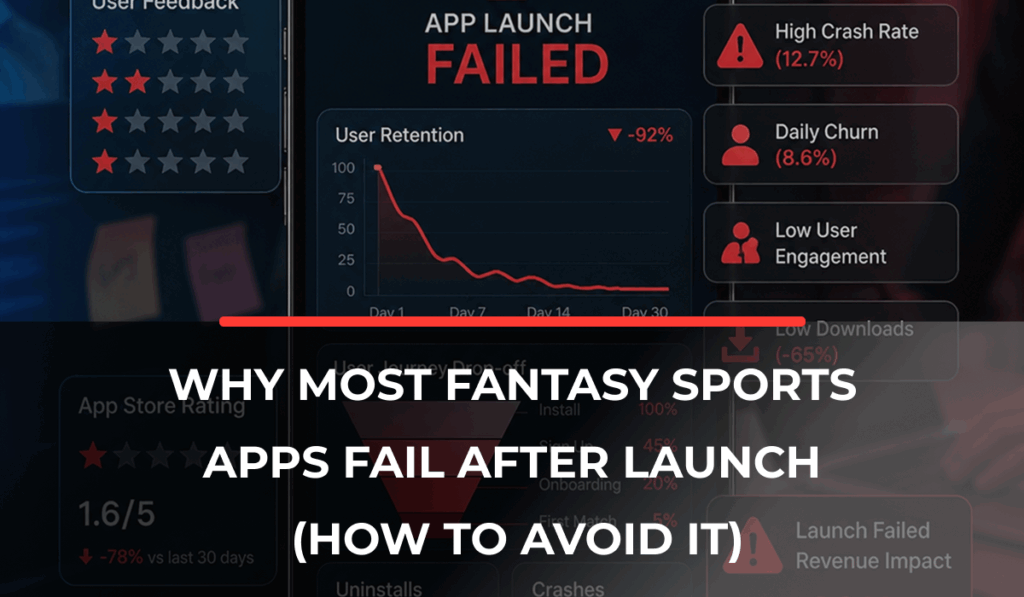
Every year in the fantasy sports industry, many apps are launched, yet only a small percentage survive beyond the first few months. One major reason is market saturation: users already have access to multiple platforms, which makes it harder for new apps to stand out or retain attention.
Another common misconception is that launching an app means the hard part is done. In reality, launch is just the beginning. Without a clear post-launch strategy, even well-built platforms struggle with performance issues, low engagement, and weak monetization.
Businesses investing in sports-based software solutions need to think beyond development and focus on long-term scalability, user retention, and continuous improvement. In this guide, we’ll break down the real reasons why fantasy sports apps fail after launch and what you can do to avoid these mistakes.
Reasons Why So Many Fantasy Sports Apps Fail After Launch
Most fantasy sports apps fail after launch because they are not built for real-world conditions like high traffic, real-time data processing, and continuous user engagement. While the idea and initial development may be strong, gaps in scalability, monetization, and post-launch planning quickly start to show.
1. Poor Scalability Planning from the Start
One of the biggest reasons fantasy sports apps fail is poor scalability planning right from the start. Many apps work fine during testing, but once real users join, especially during live match days, the system struggles to handle the load. This often results in server crashes, slow performance, and delayed real-time updates. The root issue is usually a weak backend setup combined with a lack of proper cloud optimization.
2. Weak User Experience (UX) & Retention Strategy
Many fantasy sports apps fail because the user experience is not simple or intuitive enough. When contest participation flows are complicated or interfaces feel confusing, new users often struggle to understand how the platform works. A poor mobile experience adds to the frustration, making it harder for users to stay engaged. Over time, this lack of a smooth experience directly impacts retention and overall app success, especially in platforms built through sports prediction app development, where user journey design plays a key role in engagement.
3. Lack of Real-Time Performance & Data Accuracy
Many fantasy sports apps fail because they cannot deliver accurate and real-time match data consistently. When live scores are delayed or match updates are incorrect, users quickly lose confidence in the platform. In many cases, heavy reliance on third-party APIs creates problems when those services slow down or fail unexpectedly. This kind of dependency can disrupt the entire user experience during live games.
4. Monetization Failures & Poor Revenue Strategy
Many fantasy sports apps fail because their revenue model is too narrow and short-sighted. A lot of platforms depend heavily on entry fees alone, which limits income and makes growth unstable over time. Weak referral or reward systems also reduce user acquisition and engagement and slow down organic growth. On top of that, the absence of a long-term monetization strategy creates financial pressure after launch, eventually affecting product quality and user experience.
5. Ignoring User Retention & Engagement
Many fantasy sports apps fail because they focus too much on acquiring users but not enough on keeping them active. Without gamification features like challenges, leaderboards, or rewards, users quickly lose interest after a few sessions. Weak loyalty programs also fail to give users a reason to return regularly. On top of that, the lack of personalized experiences makes the platform feel generic and less engaging over time.
6. Security & Fraud Issues
Security problems are another major reason fantasy sports apps fail after launch. Many platforms use weak authentication systems, which makes unauthorized access and account misuse easier. On top of that, bot users and fake accounts often enter contests, damaging fairness and overall user experience. Payment fraud risks also increase when financial transactions are not properly secured or monitored.
7. Poor Infrastructure & Technology Choices
Most fantasy sports apps fail after launch because their technical foundations are not properly planned from the start. In the rush to go live, businesses often pick the wrong tech stack or build systems that are not ready for real-world scale. This becomes even more problematic when businesses rely on rigid monolithic architectures without planning for future growth. These issues usually come from weak planning during fantasy sports app development, where scalability is not given enough importance early on.
8. Inadequate Testing Before Launch
Another reason fantasy sports apps may not succeed after launch is that they are not tested properly in real-world conditions before going live. Instead of simulating actual user behavior, teams often skip stress testing and assume the system will perform well. This leads to critical bugs only being discovered during live matches when user traffic is at its peak. Poor QA processes make the situation worse, as many issues go unnoticed until they directly impact users.
9. No Post-Launch Support & Maintenance Strategy
Another reason for failure is that businesses treat launch as the final step rather than the beginning. Once the app is live, there are often no regular updates, leaving performance issues and small bugs unresolved for long periods. Over time, this builds technical debt, making the system harder and more expensive to maintain. In many cases, there is also no proper monitoring in place to track errors or user behavior in real time, which is often overlooked during early-stage sports management software planning.
10. Weak Marketing & User Acquisition Strategy
Finally, most fantasy sports apps fail after launch because they struggle to bring in and retain users in a sustainable way. A lot of platforms depend too heavily on paid ads, which becomes expensive and difficult to maintain over time. At the same time, weak organic growth strategies mean there is little to no long-term visibility or consistent traffic. Poor brand positioning further adds to the problem, which makes it hard for the app to stand out in a highly competitive market.
Real-World Impact of Fantasy Sports App Failures
When fantasy sports apps fail after launch, the impact goes far beyond just technical issues. Businesses face significant revenue loss as user activity drops and monetization strategies stop performing as expected. At the same time, user trust breaks quickly, especially when issues like crashes, fraud, or inaccurate data occur repeatedly. This also damages the brand’s reputation, making it harder to attract new users or partners in the future.
Ready to Build a Fantasy Sports Platform That Can Scale?
DynamoLogic Solutions helps businesses build scalable, secure, and high-performance fantasy sports platforms designed for long-term success.
How to Avoid Fantasy Sports App Failure
Avoiding failure in fantasy sports apps is less about luck and more about how well the platform is planned and managed from the start. Most successful apps are not just well-built at launch but are continuously improved based on real user behavior and system performance.
When these areas are handled early and consistently, the chances of post-launch failure reduce significantly, especially in competitive markets like cricket fantasy app development where user expectations are high.
1. Build for Scalability from Day One
From the very beginning, the system should be designed to handle growth, not just initial users. Cloud-native architecture helps ensure flexibility, while load balancing and auto-scaling allow the platform to manage traffic spikes during live matches without breaking.
2. Focus on UX and User Journey Optimization
A simple and smooth user experience is key to retention. Clear onboarding flows help new users understand the platform quickly, while a mobile-first design ensures accessibility across devices. Continuous UX testing also helps identify friction points and improve the journey over time.
3. Invest in Real-Time Data Infrastructure
Fantasy sports apps depend heavily on real-time updates, so data accuracy is critical. Reliable sports data APIs, combined with redundant systems, help reduce downtime and errors. A low-latency architecture ensures that users receive live updates without delays.
4. Design a Strong Monetization Model Early
Revenue planning should be part of the initial strategy, not an afterthought. A balanced model that includes entry fees, subscriptions, ads, and reward systems creates multiple income streams and reduces dependency on a single source.
5. Prioritize Security & Fair Play
Trust is essential in real-money gaming platforms. Fraud detection systems, secure payment gateways, and anti-cheating algorithms help maintain fairness and protect users from financial risks and manipulation.
6. Continuous Post-Launch Optimization
Launching the app is only the start. Regular performance monitoring, feature updates, and user feedback integration ensure the platform keeps improving. This ongoing optimization is what separates short-lived apps from long-term successful platforms.
Why Most Startups Underestimate Fantasy Sports Complexity
Many startups enter the fantasy sports market thinking it is just about building an app and launching it quickly, but the reality is much more complex. These platforms require strong real-time systems, high-performance infrastructure, and careful handling of live user activity.
On top of that, regulatory requirements and intense competition make it even harder to succeed without proper planning. As a result, many teams only realize the true difficulty after launch when issues start affecting users and performance.
Key Challenges Startups Often Underestimate:
- Handling live scores, updates, and instant data sync without delays or errors.
- Managing sudden traffic spikes when thousands or millions of users join during live events.
- Navigating different legal frameworks, especially for real-money gaming platforms.
- Competing with already trusted and feature-rich fantasy sports apps in the market.
Why Professional Development Partners Reduce Failure Risk
Working with experienced development partners significantly reduces the chances of failure in fantasy sports projects because they understand the technical and business complexities involved.
- Industry expertise in fantasy sports systems: Deep understanding of real-time gaming, user behavior, and platform requirements helps avoid common beginner mistakes.
- Proven scalable architectures: Use of tested system designs that can handle high traffic, live match spikes, and long-term growth without performance issues.
- End-to-end QA and testing: Thorough testing before and after launch to detect bugs, performance issues, and security gaps early.
- Long-term support and optimization: Continuous maintenance, updates, and performance improvements to keep the platform stable and competitive over time.
Why Choose DynamoLogic Solutions for Fantasy Sports Development
At DynamoLogic Solutions, we focus on building fantasy sports platforms that are not just functional at launch but are designed to perform and scale in real-world conditions. Our approach combines technical depth with product thinking to ensure long-term stability, user engagement, and business growth. From architecture to post-launch support, we align every stage of development with industry demands.
- Scalable fantasy sports platform architecture: We design systems that can handle rapid user growth and high-traffic match days without performance issues.
- Real-time data integration expertise: Our solutions ensure fast, accurate, and reliable live updates for a seamless user experience.
- Secure and fraud-resistant systems: We implement strong security layers to protect transactions, user data, and platform integrity.
- UI/UX-driven product development: We focus on clean, intuitive interfaces that improve onboarding, engagement, and retention.
- Post-launch maintenance and optimization support: We continuously monitor, update, and optimize platforms to ensure long-term performance and stability.
Looking to build a scalable and high-performance fantasy sports platform?
Partner with us to turn your idea into a reliable, user-friendly, and revenue-ready product built for long-term success.
FAQs
Why do most fantasy sports apps fail?
Most fantasy sports apps fail due to poor scalability, weak user experience, lack of real-time data accuracy, and ineffective monetization strategies. Many also struggle because they do not plan properly for post-launch support and long-term growth.
How do you make a successful fantasy sports app?
A successful fantasy sports app requires strong technical architecture, smooth user experience, reliable live data integration, and a balanced revenue model. Continuous updates and user feedback also play a key role in long-term success.
What is the biggest challenge in fantasy sports development?
The biggest challenge is managing real-time performance during high-traffic live matches. Ensuring accurate data updates, system stability, and a seamless user experience under pressure is often complex.
How important is scalability in fantasy sports apps?
Scalability is critical because user traffic can spike suddenly during live events. Without a scalable system, apps may crash, slow down, or fail to deliver real-time updates, leading to user loss.
How do fantasy sports apps make money?
Fantasy sports apps typically earn through entry fees, subscriptions, advertisements, in-app purchases, and sometimes partnerships or sponsorships. A diversified monetization strategy is usually more stable.