A fantasy sports platform needs more than a good interface and strong features. It also needs an infrastructure setup that can handle real-time activity, growing users, and busy match periods without affecting performance.
Cloud architecture for fantasy sports apps helps businesses build platforms that are more scalable, reliable, and easier to manage as they grow. The right architecture can support high availability, faster recovery, and better use of cloud resources.
For businesses planning fantasy sports app development, cloud architecture should be considered early. The infrastructure should support current requirements while leaving enough room for future users, new sports, and expanding business needs.
Why Cloud Architecture Matters for Fantasy Sports Platforms
Fantasy sports platforms can experience very different levels of activity throughout the year. A normal day may have moderate traffic, while a major tournament can bring a sudden increase in users, contests, live score requests, and other activity.
A well-planned cloud architecture helps the platform handle these changes without affecting the user experience. It can support reliable access, better performance, and faster recovery when something goes wrong.
Live Competitions
Users expect fantasy contests and match information to remain available while games are in progress. A reliable architecture helps support these real-time activities and reduces the risk of service interruptions.
Real-Time Updates
Fantasy platforms often depend on continuous updates for scores, player statistics, fixtures, and rankings. The underlying infrastructure needs to support this activity consistently.
Growing User Base
As more users join the platform, infrastructure requirements also change. Cloud architecture can provide greater flexibility for growth, reducing the need for major redesigns as usage increases.
High Availability
Downtime during an important match can quickly affect user trust and business revenue. Designing for high availability helps keep important services accessible even when individual components experience problems.
Business Continuity
A strong architecture also considers what happens when something fails. Backups, redundancy, monitoring, and recovery planning can help businesses restore services and protect operations.
These considerations make fantasy sports cloud architecture an important part of building a platform that can support long-term growth rather than only meeting launch-day requirements.
What Is Cloud Architecture?
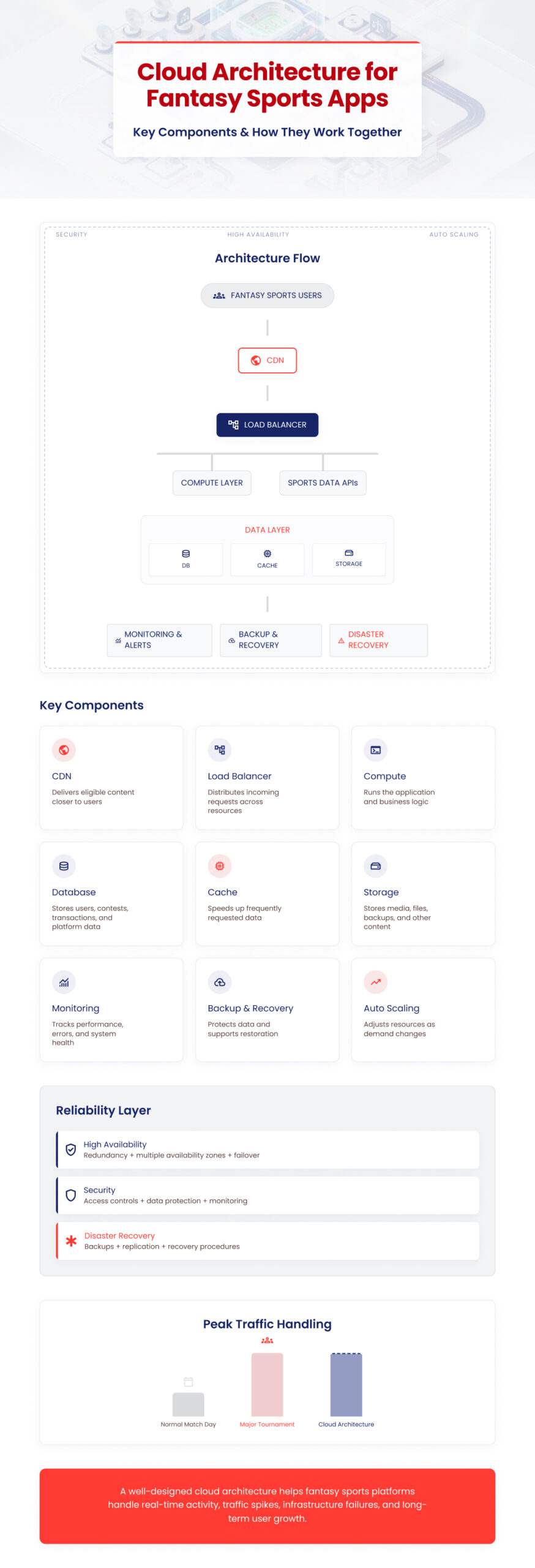
Cloud architecture is the way different cloud resources and services are organized to work together. Instead of relying on one server or one system, a fantasy sports platform can use multiple connected components to handle applications, data, traffic, storage, monitoring, and recovery.
Cloud Infrastructure
Cloud infrastructure provides the resources needed to run the platform. These can include computing resources, databases, storage, networking, and other managed services.
Distributed Systems
A distributed setup allows different parts of the platform to perform different responsibilities. If one component has an issue, the entire platform does not necessarily need to stop working.
Services Working Together
A fantasy sports platform may use application servers, databases, content delivery services, monitoring tools, backups, and other cloud services. The architecture defines how these components work together to support the overall product.
Hosting vs Cloud Architecture
Hosting mainly refers to where the application runs. Cloud architecture goes further by considering how different resources are connected and managed for performance, availability, security, recovery, and growth.
For example, choosing AWS, Azure, or Google Cloud is a cloud technology decision. Deciding how those services should work together to support a reliable fantasy sports platform is an architecture decision.
A well-planned fantasy sports tech stack and cloud architecture should therefore work together. The technology choices provide the building blocks, while the architecture determines how those building blocks support the business.
Core Components of a Cloud Architecture
A fantasy sports platform usually depends on several cloud components working together. Each component has a different role, and the right combination helps support performance, availability, and future growth.
| Component | Purpose | Business Benefit |
|---|---|---|
| Compute Services | Run the application and business services | Provides the processing power needed to serve users and platform functions |
| Storage | Store files, media, backups, and other data | Provides reliable access to important information |
| Databases | Store structured platform data such as users, contests, and transactions | Supports reliable data management and application performance |
| Networking | Connects users, applications, databases, and external services | Helps data move securely and efficiently |
| Load Balancers | Distribute incoming requests across available application resources | Helps distribute traffic and reduce the risk of individual resources becoming overloaded. |
| CDN | Delivers static content from locations closer to users | Can improve loading speed for users in different regions |
| Monitoring | Tracks system health, errors, performance, and availability | Helps teams identify problems and respond faster |
| Backup & Recovery | Creates copies of important data and supports restoration | Reduces the impact of data loss or service failures |
Compute Services
Compute resources run the application and its main services. The required capacity can change as the number of users and platform activity increases.
Storage
Storage can hold files, images, documents, backups, and other content. Reliable storage helps protect important business data while keeping it available when needed.
Databases
Databases manage important information such as user profiles, contests, transactions, and match-related data. Database choices should match the platform’s workload and expected growth.
Networking
Networking connects different parts of the platform and allows communication between users, application services, databases, and third-party providers.
Load Balancers
A load balancer distributes incoming requests across available application resources. This helps maintain a more balanced workload and can improve reliability.
— AWS, Health Checks for Application Load Balancer Target Groups
CDN
A content delivery network, or CDN, caches and delivers eligible content from locations closer to users. This can help improve loading times, especially when a platform serves users across different regions.
Monitoring
Monitoring provides visibility into uptime, performance, errors, and system health. It helps teams identify issues before they create a larger impact. Security monitoring should also be part of the architecture, helping teams identify suspicious activity and potential threats.
Backup & Recovery
Backups protect important information by maintaining recoverable copies of data. Recovery planning also helps businesses restore services when unexpected failures occur.
Build a Scalable Fantasy Sports App
Your fantasy sports platform needs infrastructure that can handle peak traffic, real-time activity, and future growth. Talk to our experts to plan a secure, reliable, and scalable architecture built around your business requirements.
Benefits of Cloud Architecture for Fantasy Sports Platforms
A well-planned cloud architecture can provide several business benefits beyond simply hosting a fantasy sports application. It gives businesses more flexibility as users, sports, and platform activity increase.
Scalability
Cloud resources can be adjusted as demand changes. This gives businesses more flexibility when user activity grows or becomes higher during major sporting events.
Faster Deployment
Cloud services can support faster release and deployment processes. Teams can make changes and introduce updates without relying on a single physical infrastructure setup.
Improved Reliability
Monitoring, backups, redundancy, and managed cloud services can help reduce operational risks. A reliable environment also supports a more consistent experience for users.
Lower Operational Overhead
Cloud platforms can reduce the need to manage physical servers and some underlying infrastructure, allowing teams to focus more on application and business requirements.
High Availability
A properly designed cloud environment can reduce dependence on a single resource. Redundancy and failover planning can help keep important platform services available when an individual component has a problem.
Better Disaster Recovery
Cloud environments can support backup and recovery strategies that help businesses restore important services and data after unexpected failures.
Global Reach
Businesses serving users in multiple regions can use cloud infrastructure to support geographic expansion. Content delivery and distributed resources can help provide a more consistent experience across locations.
Designing for High Availability
High availability means keeping important platform services accessible even when a component experiences a failure. This is especially important for fantasy sports platforms where users may be actively joining contests and checking live information.
Redundancy
Redundancy means having more than one resource available for important services. If one resource becomes unavailable, another can continue supporting the platform.
Multiple Availability Zones
Major cloud providers offer multiple isolated availability zones within many regions. Distributing important services across multiple zones can reduce the impact of a problem affecting one location.
Failover
Failover allows the platform to redirect operations to an available resource or environment when the primary resource experiences a problem. This can help reduce downtime and maintain important services.
Health Checks
Health checks regularly verify whether important services are working properly. If a problem is detected, the platform can respond based on the architecture and recovery plan.
— AWS, Health Checks for Application Load Balancer Target Groups
High availability does not mean that downtime can never happen. It means the platform is designed to reduce the likelihood and impact of failures.
For a fantasy sports platform, these principles are especially useful during important matches when even a short interruption can affect many active users. High availability should therefore be considered during fantasy sports software development, rather than added only after the platform begins experiencing reliability issues.
Planning for Disaster Recovery
Even a well-designed cloud environment can experience unexpected failures. Disaster recovery planning helps a fantasy sports business prepare for events such as system failures, data loss, service interruptions, or other major incidents.
Backups
Important platform data should be backed up regularly. Backups provide a recovery point if information is accidentally deleted, corrupted, or affected by a system failure.
Recovery Objectives
Two simple measures can help businesses define recovery expectations:
- RTO (Recovery Time Objective): The target amount of time within which the platform should be restored after a disruptive event.
- RPO (Recovery Point Objective): How much recent data the business can afford to lose if recovery is required.
These targets help businesses decide how much recovery capability they actually need.
Data Replication
Important data can be maintained across more than one location or resource. This can provide an additional layer of protection if the primary environment becomes unavailable.
Business Continuity
Disaster recovery is part of a wider business continuity plan. The goal is not only to restore technology but also to keep important business operations moving during unexpected events.
Recovery plans should also be tested regularly. A backup or recovery process that has never been tested may not work as expected when it is actually needed.
Cloud Cost Optimization
Cloud architecture should support business growth without creating unnecessary infrastructure costs. Paying for more resources than the platform needs can increase expenses, while using too few resources can affect performance.
Choose the Right Resources
Cloud providers offer different resource sizes and service options. Businesses should select resources based on actual platform requirements rather than automatically choosing the most powerful option.
Scale Based on Demand
Platform activity can change throughout the day and across sports seasons. Resources should be planned around expected demand so businesses are not paying for large amounts of unused capacity during quieter periods.
Monitor Cloud Usage
Regular cost reviews can show which services consume the most resources. Usage reports can help teams identify unused resources, unexpected increases, or areas that need optimization.
Avoid Overprovisioning
Adding extra resources for every possible future scenario can make the platform unnecessarily expensive. A better approach is to build enough capacity for expected growth while keeping room to adjust as demand changes.
Review Costs as the Platform Grows
Cloud costs can change as user numbers, sports, regions, and platform activity increase. Regular reviews help businesses keep infrastructure spending aligned with actual business needs.
Cloud optimization should therefore be considered alongside fantasy sports app development pricing. The goal is not simply to reduce cloud spending but to achieve a sensible balance between cost, performance, reliability, and future growth.
Common Cloud Architecture Mistakes
A cloud environment can become difficult to manage when architecture decisions are made without considering future users, business requirements, and reliability. Avoiding common mistakes can help businesses build a more practical foundation.
Creating a Single Point of Failure
Relying on one critical resource can make the entire platform vulnerable when that resource fails. Important services should have suitable redundancy and recovery options.
Having No Disaster Recovery Plan
Backups alone are not enough. Businesses should also know how they will restore important services and data if a major failure occurs.
Poor Monitoring
Without proper monitoring, teams may not know when performance or availability starts to decline. Early visibility allows problems to be addressed before they affect more users.
Ignoring Future Growth
An architecture designed only for the current number of users may become difficult to expand later. Growth expectations should be considered when making major infrastructure decisions.
Overcomplicating Infrastructure
More cloud services do not always mean a better architecture. Unnecessary complexity can increase costs and make the platform harder to manage.
Underestimating Traffic
Fantasy sports activity can increase sharply during major matches and tournaments. Planning only for average traffic can leave the platform unprepared during busy periods.
A good architecture should be scalable without being unnecessarily complicated. Businesses should focus on the infrastructure they actually need today while making sensible provisions for future growth.
When Should You Upgrade Your Cloud Architecture?
A cloud architecture does not need to be redesigned every time the platform grows. However, certain changes can show that the existing setup is no longer suitable for the business.
Growing User Base
A significant increase in users can change infrastructure requirements. If the current architecture struggles to maintain performance or availability, an upgrade may be needed. Understanding the full fantasy sports development process can also help businesses plan infrastructure requirements before development begins.
Entering New Markets
Expanding into new countries or regions can create new requirements for availability, data management, performance, and user access.
Supporting Additional Sports
Adding more sports can increase the amount of real-time data, contests, and user activity the platform needs to handle. The architecture should be reviewed before major expansion.
Seasonal Traffic Growth
If traffic consistently increases during major tournaments, the existing architecture should be evaluated to ensure it can support these periods reliably. Regular fantasy sports app maintenance can also help identify performance issues and infrastructure requirements before peak periods.
Enterprise Customers
Enterprise clients may have higher expectations around availability, reliability, monitoring, and business continuity. Meeting these requirements may require changes to the existing architecture.
An upgrade should be based on a clear business or performance need rather than simply adopting newer cloud services. Regular architecture reviews can help identify the right time to make changes before existing limitations become a major problem.
Cloud Readiness Checklist
Before launching a fantasy sports platform, businesses should review whether the cloud environment is ready to support users, data, and future growth.
- Multi-zone deployment planned for important services.
- Backup strategy established for critical platform data.
- Monitoring and alerts configured for performance, errors, and availability.
- Disaster recovery plan documented and tested.
- Capacity planning completed for expected user activity and peak periods.
- Cost monitoring enabled to track cloud usage and spending.
- Security controls reviewed for applications, data, and access.
- Performance testing completed before launch and major releases.
- Architecture documentation maintained so teams understand the environment and recovery procedures.
Conclusion
Cloud architecture plays an important role in keeping a fantasy sports platform scalable, reliable, and available as the business grows. The right setup can support real-time activity, protect business continuity, manage costs, and prepare the platform for future expansion.
A strong architecture does not need to be unnecessarily complex. It should match the platform’s current requirements while providing enough flexibility for growing users, new sports, seasonal demand, and new markets.
Businesses planning fantasy sports software development should consider cloud architecture early in the project. A well-planned foundation can reduce future infrastructure challenges and support a more reliable platform over the long term.
Build a Fantasy Sports App Ready to Scale
Ready to turn your fantasy sports idea into a reliable, high-performance app? Partner with DynamoLogic to build a cloud-ready fantasy sports solution designed for scalability, high availability, security, and long-term growth.
FAQs
Why do fantasy sports apps need cloud architecture?
Fantasy sports apps can have many users accessing the platform at the same time, especially during live matches. Cloud architecture helps distribute workloads, support high traffic, keep services available, and reduce the risk of downtime.
What is cloud architecture in fantasy sports software?
Cloud architecture is the way cloud resources and services are organized to run a fantasy sports platform. It can include application servers, databases, storage, networking, load balancing, monitoring, and backup systems that work together to support the platform.
How does cloud architecture improve scalability?
A well-designed cloud architecture allows a platform to increase or reduce resources based on business needs. This helps a fantasy sports platform support user growth and periods of higher activity without depending on fixed infrastructure.
What is high availability in cloud architecture?
High availability means designing a platform so that services can continue working even when one part of the infrastructure has a problem. Redundancy, multiple availability zones, health checks, and failover strategies can help reduce downtime.
Why is disaster recovery important for fantasy sports platforms?
Fantasy sports platforms handle important user, contest, and transaction data. A disaster recovery plan helps protect this data and allows the business to restore services after events such as infrastructure failures, data loss, or major outages.