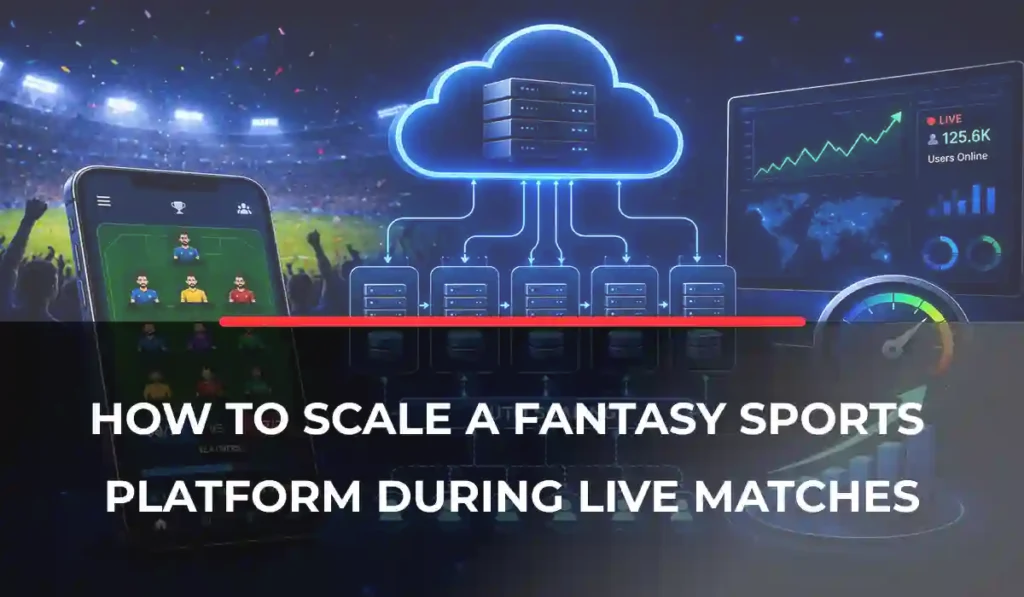
A fantasy sports platform may work well during normal hours and still struggle when a major match begins. Thousands or even millions of users may join contests, check scores, update teams, view leaderboards, and make payments within a short period.
Scaling a fantasy sports platform means preparing the system to handle these sudden changes in demand while keeping the experience fast and reliable. Good scalability protects user trust, reduces downtime, and helps businesses avoid losing revenue during their most important match periods.
For businesses planning fantasy sports app development, scalability should be part of the planning from the beginning. The platform should be designed to handle current traffic while also allowing room for larger contests, new sports, and future growth.
Why Live Matches Create Massive Traffic Spikes
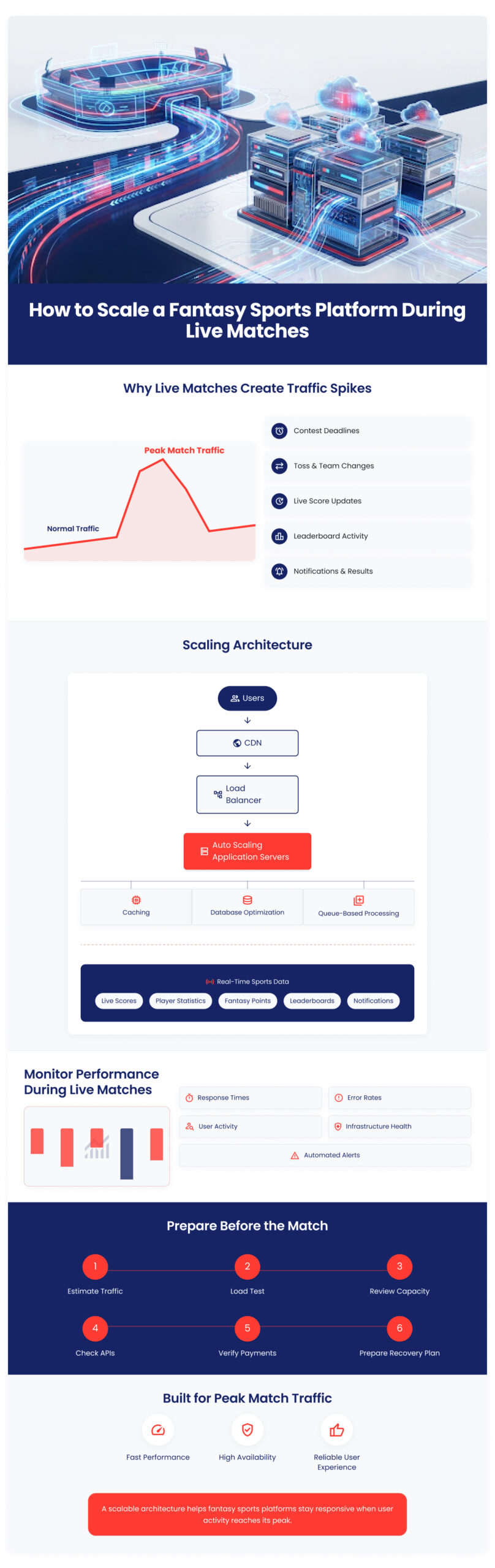
Fantasy sports traffic does not grow at a steady rate. Most activity is concentrated around important moments of a match. A platform that handles normal daily traffic may suddenly face several times more users within a few minutes.
Contest Deadlines
Many users join contests just before the deadline. This creates a short period where large numbers of people may be selecting teams, entering contests, and completing payments at the same time.
Toss and Team Selection
In cricket, the toss can lead to a sudden increase in activity because users may change their teams based on the playing XI, pitch conditions, or other match information.
Live Score Refreshes
Once a match starts, users repeatedly check scores, player performances, points, and rankings. These requests can create continuous traffic throughout the game. Dream 11’s engineering manuals discuss the enormous read/update requirements around fantasy leaderboards.
Leaderboard Updates
Users want to see how their teams are performing against others. Frequent leaderboard and points updates can create another major workload during live contests.
Notifications and Prize Updates
Match events can trigger large numbers of notifications. Prize announcements and contest results can also create additional activity after the match.
The main challenge is traffic concentration. A platform may have manageable average traffic but still experience extreme demand during a few critical minutes. That is why fantasy sports platform scaling needs to account for peak activity, not only average usage.
What Happens When a Platform Does Not Scale?
A fantasy sports platform can have strong features and still lose users if it cannot handle sudden traffic increases. Performance problems become more visible during the exact moments when users are most active.
Slow Loading
Pages may take longer to open when too many requests reach the platform at once. Users may struggle to view contests, scores, player information, or leaderboards.
Failed Contest Entries
If the platform cannot process requests quickly enough, users may fail to join contests before deadlines. This can directly affect both user satisfaction and revenue.
Payment Failures
High traffic can also put additional pressure on payment and transaction services. Delays or failures in deposits and contest entry payments can create frustration and increase support requests.
Login Issues
A sudden increase in login attempts can put additional pressure on authentication services. Users may face delays or failed login attempts when they are trying to access the platform before a match.
Lost Users
Repeated performance issues can make users lose confidence in the platform. They may move to competitors that provide a smoother experience during important matches.
Negative Reviews
Poor performance during major events can quickly lead to negative feedback and reviews. These experiences can also affect how potential users view the brand.
Revenue Loss
The biggest business impact can be lost revenue. If users cannot enter contests, complete payments, or access the platform during peak periods, the business may lose transactions that cannot be recovered later.
For this reason, fantasy sports scalability is directly connected to user experience and business continuity. Handling peak demand is not only a technical concern. It is also a way to protect revenue and brand reputation.
What Does Scalability Mean?
Scalability is the ability of a fantasy sports platform to handle increasing numbers of users and activity without causing major performance problems. The goal is to give users a consistent experience as demand changes.
There are three common ways to think about scalability.
Vertical Scaling
Vertical scaling means giving an existing resource more capacity, such as additional processing power or memory.
It can be useful when a platform needs more capacity quickly, but it has limits because a single resource can only grow so much.
Horizontal Scaling
Horizontal scaling means adding more resources to share the workload. Instead of relying on one application server, multiple servers can handle requests together.
This approach can provide more flexibility as the user base grows and is often important for platforms that need to handle large traffic volumes.
Elastic Scalability
Elastic scalability means resources can increase or decrease based on demand. More capacity can be available during a major match, while unnecessary resources can be reduced during quieter periods.
For fantasy sports platforms, scalability is about more than supporting a larger number of users. It means being ready for sudden changes in activity while keeping important functions such as contests, scores, payments, and rankings responsive. A scalable approach gives businesses more flexibility as their platform and audience grow.
Key Strategies for Scaling Fantasy Sports Platforms
Scaling a fantasy sports platform requires several parts of the system to work together. No single solution can handle every traffic challenge. The right strategy depends on the platform, expected user activity, and business requirements.
Load Balancing
A load balancer distributes incoming user requests across multiple application resources instead of sending everything to one place.
This helps prevent individual resources from becoming overloaded and can improve platform availability during busy periods.
Business benefit: Users get more consistent performance, while the platform has greater capacity to handle high traffic.
Auto Scaling
Auto scaling allows available resources to increase when demand rises and reduce when demand falls.
For example, a platform may need significantly more capacity before and during a major match than it does during quieter hours.
Business benefit: Businesses can prepare for peak traffic without permanently paying for maximum capacity.
Caching
Caching keeps frequently requested information available for faster access. Fantasy sports platforms can benefit when many users request the same information, such as match details, player statistics, or other frequently viewed content.
Business benefit: Faster responses can improve the user experience and reduce unnecessary pressure on other platform resources.
Content Delivery Networks
A CDN delivers certain content from locations closer to users. This can help improve loading times when a platform serves users across different regions.
Business benefit: Users can receive content faster, which supports a smoother experience during high-traffic periods.
Database Optimization
The database handles important information such as users, contests, teams, transactions, and scores. Database performance at scale becomes particularly important when heavy activity places significant demand on the system during live matches.
A scalable approach considers how database workloads should be managed as usage increases.
Queue-Based Processing
Some activities do not need to be completed at the exact moment a user makes a request. Queue-based processing allows certain tasks to be handled in an organized sequence instead of processing everything simultaneously.
This can be useful for activities such as notifications and other background tasks.
Business benefit: Separating background work from immediate user actions can help keep the main platform responsive.
Monitoring and Alerting
Scaling also requires visibility. Monitoring helps teams track response times, errors, traffic levels, and resource health during busy periods.
Alerts can notify teams when performance moves outside expected levels.
Business benefit: Problems can be identified and addressed earlier, reducing the chance of extended downtime during important matches.
These strategies work best when they are planned as part of the wider cloud architecture for fantasy sports apps, rather than added separately after traffic problems appear.
Build a Fantasy Sports Platform Ready for Peak Traffic
Launch a scalable fantasy sports platform built to handle live-match traffic, real-time updates, and growing user demand. DynamoLogic can help you design the right architecture and features for reliable performance at scale.
Managing Real-Time Events
Real-time activity makes fantasy sports platforms more demanding than many standard applications. During a live match, users expect scores, rankings, notifications, and contest information to update quickly and accurately.
Live Score Updates
Scores and player statistics may change frequently during a match. The platform needs to process these updates efficiently while serving information to a large number of users.
Leaderboards
Leaderboards can change continuously as players earn points. Large numbers of users may check their rankings at the same time, especially after important match events. This is an important consideration when businesses build a fantasy sports app like Dream11, where real-time scoring and leaderboard updates need to remain reliable during peak activity.
Notifications
Match events can trigger notifications for users. These may include player performance updates, contest results, match alerts, or other important events.
Contest Calculations
Fantasy points and contest rankings may need to be updated as match data changes. The platform must manage these updates reliably so users receive accurate information.
Payment Confirmations
Payments and contest entries also need reliable processing during busy periods. Delays or failed confirmations can create confusion and affect the user experience.
Real-time events should be planned around both speed and reliability. A platform that delivers updates quickly but produces inconsistent results can create just as much frustration as a slow platform.
Businesses that depend on external sports data should also consider the reliability and capacity of their fantasy sports API integration, since live match information is often a critical part of the overall user experience.
Preparing for Major Sports Events
Major sporting events can bring a sharp increase in fantasy sports activity. Businesses should prepare well before the event rather than waiting for traffic to increase.
Estimate Expected Traffic
Review previous user activity, contest participation, and event popularity to estimate how many users may be active at the same time. Planning around peak demand gives teams a more realistic capacity target and can also influence fantasy sports app development costs.
— Source: AWS Well-Architected Framework
Test Before the Event
Load and stress testing can help identify performance limitations before users experience them. Important journeys such as login, team creation, contest entry, payments, and leaderboard access should be tested under expected traffic conditions.
Review Infrastructure Capacity
Application resources, databases, APIs, and other important services should be reviewed before a major event. Teams should confirm that the platform can handle expected demand and has room for unexpected increases.
Check Third-Party Services
Sports data providers, payment gateways, authentication services, and notification providers can also become important dependencies during peak activity. Their limits and availability should be reviewed as part of event preparation.
Prepare an Operations Team
A clear response plan helps teams react quickly if performance drops or an unexpected issue occurs. Important responsibilities, communication channels, and escalation procedures should be defined before the event begins.
Events such as the IPL, FIFA World Cup, NFL season, Cricket World Cup, and NBA playoffs can create very different traffic patterns. Preparation should therefore be based on the expected audience and event schedule rather than using one standard capacity target for every competition.
Performance Monitoring During Live Matches
Monitoring becomes especially important when a fantasy sports platform is handling high traffic. Teams need to know what is happening across the platform while users are actively joining contests and following matches.
Response Times
Track how quickly important pages and actions respond. A sudden increase in response time can indicate that a service is struggling with the current workload.
Error Rates
Error rates can show whether requests are failing more often than expected. Monitoring errors during a live match helps teams identify problems before they affect a larger number of users.
User Activity
Real-time user activity can show how quickly traffic is increasing. Comparing current activity with expected levels can help teams recognize unusual demand early.
Infrastructure Health
Teams should monitor the health of application resources, databases, APIs, and other important services. Changes in resource usage can indicate that additional capacity or intervention may be required.
Alerting
Automated alerts can notify the operations team when important metrics cross defined limits. This allows problems to be investigated while the event is still taking place.
Effective monitoring gives businesses visibility into platform health when it matters most. It also supports ongoing fantasy sports app maintenance by helping teams identify performance patterns and issues that may require attention after the event.
“Effective performance monitoring should track key metrics such as latency, errors, availability, and resource health, with alerts helping teams respond when performance falls outside expected thresholds.”— Source: AWS Well-Architected Framework, Reliability Pillar
Common Scalability Mistakes
Many performance problems during major matches come from planning for normal traffic instead of real peak demand. A few common mistakes can make a fantasy sports platform difficult to scale when users are most active.
Assuming Average Traffic
Average daily traffic does not show what happens during contest deadlines or major match events. Planning only around average usage can leave the platform unprepared for sudden spikes.
Skipping Stress Testing
A platform may appear stable during normal testing but struggle under heavy demand. Load and stress testing can help identify limitations before a major event.
Relying on a Single Server
Depending on one critical resource creates a potential single point of failure. A problem with that resource can affect a large part of the platform.
Having No Caching Strategy
Repeated requests for the same information can create unnecessary pressure on application and database resources. A suitable caching approach can help reduce this load.
Delaying Monitoring
Finding out about a performance problem only after users start reporting it can make the issue harder to control. Monitoring and alerts should be prepared before high-traffic events.
Ignoring Database Bottlenecks
Application resources may scale successfully while the database becomes the limiting factor. Database capacity and performance should therefore be considered as part of the overall scaling plan.
Avoiding these mistakes helps businesses prepare for high fantasy sports traffic with greater confidence. Scalability should be tested and reviewed before peak events rather than treated as a problem to solve during the match.
Scalability Planning Checklist
Before a major sporting event, businesses should review the platform from both performance and operational perspectives. A simple readiness check can help identify issues before traffic reaches its peak.
- Estimate concurrent users based on expected match-day activity.
- Test peak traffic to identify performance limits before the event.
- Verify auto scaling and confirm that additional capacity can become available when demand increases.
- Review load balancing to ensure traffic can be distributed across available resources.
- Check caching for frequently requested content and match data.
- Validate database performance under expected workloads.
- Review API limits and confirm that external sports data services can support expected demand.
- Test payment capacity for deposits and contest entries during busy periods.
- Monitor key metrics such as response times, errors, traffic, and resource health.
- Confirm rollback and recovery plans so the team can respond quickly if an unexpected issue occurs.
- Prepare the incident response team with clear responsibilities and escalation procedures.
Conclusion
Live matches can create some of the highest traffic periods for a fantasy sports platform. Contest deadlines, live scores, leaderboards, payments, and notifications can all place heavy demand on the platform at the same time.
A scalable approach helps businesses handle these traffic spikes while protecting performance, user experience, and revenue. Load balancing, auto scaling, caching, database planning, monitoring, and proper testing all have a role in preparing the platform for peak demand.
Businesses planning fantasy sports software development should consider scalability from the beginning instead of waiting for performance problems to appear. The right approach can help the platform support major sporting events today while creating room for much larger audiences in the future.
Ready to Build a Fantasy Sports Platform That Scales?
Peak match traffic can put every part of a fantasy sports platform to the test. DynamoLogic Solutions can help you build a scalable, high-performance platform designed to handle live-match demand, real-time updates, and growing user activity.
FAQs
How do fantasy sports platforms handle millions of users?
Large fantasy sports platforms use scalable infrastructure and several performance strategies to handle high traffic. Load balancing, auto scaling, caching, database planning, and real-time monitoring help distribute demand and maintain performance during busy matches.
Why do fantasy sports apps slow down during live matches?
Traffic can increase sharply when users join contests, check live scores, view leaderboards, and receive notifications. If the platform is designed only for average traffic, these sudden increases can overload application or database resources.
What is scalability in fantasy sports software?
Scalability is the ability of a platform to handle increasing users and activity without major performance problems. It includes preparing the system for both long-term growth and sudden traffic spikes during important matches.
How does load balancing improve fantasy sports performance?
Load balancing distributes incoming requests across available application resources. This prevents too much traffic from being concentrated on one resource and can improve both performance and availability.
Why is caching important for fantasy sports platforms?
Caching can store frequently requested information so it can be delivered faster without repeatedly processing the same request. This can reduce pressure on application and database resources during high-traffic periods.
How should businesses prepare for major sporting events?
Businesses should estimate peak users, perform load testing, review infrastructure capacity, check third-party service limits, verify monitoring, and prepare an incident response plan before the event begins.